Announcing our SOC2 Type 2 Compliance.
Categories
Blog INSIGHTS

Around the Thanksgiving Table: How Financial Advisors Can Help Clients Start the Estate Planning Conversation

As Thanksgiving approaches, families gather together to reflect, share memories, and appreciate one another. While the holiday is often focused on gratitude, it also presents a unique opportunity to introduce important conversations, like estate planning. For financial advisors working with clients and their families, this time of year can offer an ideal moment to guide clients toward having these crucial discussions with loved ones. Here’s how to approach estate planning in a way that fosters understanding, openness, and long-term planning.

Create a Comfortable Setting for Conversations

The Thanksgiving holiday provides a natural, relaxed environment for estate planning discussions. Financial advisors can help clients understand how to bring up the topic gently, perhaps during quieter moments when families are engaged in sharing memories. By emphasizing that it’s about preparing for the future rather than focusing on the daunting aspects of death, clients can initiate conversations that feel natural and empowering rather than uncomfortable or rushed.

Position Estate Planning as a Family Benefit

Rather than framing estate planning as a task, encourage clients to highlight its value as a tool for peace of mind and family unity. By planning ahead, families can ensure that assets are distributed according to their wishes and that loved ones are cared for. For financial advisors, helping clients position estate planning in this light can turn what may seem like an intimidating subject into one that feels proactive, supportive, and considerate of family members’ needs.

Foster a Sense of Togetherness in Planning

Estate planning is more than legal documents—it’s about preserving family legacies and strengthening connections. Financial advisors can guide clients in thinking about how their estate plan will protect both their financial assets and the family bonds they’ve worked to nurture. By encouraging clients to view the process as a shared family goal, financial advisors can make estate planning feel like a collaborative endeavor that benefits everyone involved.

Lead with Empathy and Understanding

Acknowledge that estate planning can stir up complex emotions. Each family member may have different feelings about aging, legacy, and wealth distribution. Financial advisors can assist their clients in leading these discussions with empathy, ensuring all voices are heard and respected. This approach will foster an atmosphere of mutual understanding, making the conversation about estate planning less intimidating and more about ensuring that everyone feels comfortable and valued.

Use Personal Stories to Encourage Reflection

Thanksgiving is a time of reflection, which provides an opportunity for financial advisors to encourage clients to share personal stories about their family’s legacy and what they hope to pass down. By sharing stories of personal experiences, clients can see estate planning as a continuation of their family narrative, making the conversation more relatable and heartfelt.

Keep the Dialogue Open and Ongoing

While Thanksgiving may be the perfect opportunity to start the conversation, estate planning is an ongoing process. Encourage clients to view this as just the beginning of a broader conversation with their families, one that can continue beyond the holiday season. Financial advisors can position themselves as a long-term partner in these conversations, offering guidance and tools to help clients revisit and refine their plans as circumstances change.

Conclusion

By guiding clients to approach estate planning conversations with their families during Thanksgiving, financial advisors can help their clients prepare for the future with a sense of peace and purpose. The goal isn’t to rush the process but to initiate an ongoing dialogue that ensures that family legacies are protected, and the right decisions are made for future generations. With the right approach, estate planning can be a meaningful and empowering conversation, benefiting both families and the advisors that help them navigate these important decisions.

Categories
Blog INSIGHTS

Learning While Doing Estate Planning: How our focus on smart, “just-in-time” estate education makes the big difference


Video Transcript:

In the hyper-competitive financial services landscape, institutions strive to uncover new ways to offer more value, and deepen customer relationships. Digital estate planning is a easily rendered offering which does both – increase client engagement and enhance loyalty.

Comprehensive Estate Planning Education

The OneDigitalTrust platform includes comprehensive estate education tools, designed to enrich user-understanding of key topics. This empowers them to navigate important legal and financial decisions with confidence, enhancing their overall financial literacy. The platform includes smart capabilities which uncover client-specific needs and serve the Advisor with most relevant, just-in-time education. This positions Advisors as comprehensive financial partners, offering personalized, and timely estate planning education and information.

Just-In-Time Educational Capabilities

At its core, OneDigitalTrust has powerful built-in, just in time, educational capabilities to keep both advisors and users informed through the estate planning journey. We believe, integrating “Smart estate education” into the platform helps advisors and institutions foster deeper engagement, build lasting relationships, to effectively drive both, growth and retention.

Categories
Blog INSIGHTS

Avoid These Real-Life Horror Stories: The Importance of Estate Planning for Your Members, Customers and Employees This Halloween

As Halloween approaches, financial advisors and institutions must prepare for more than just haunted houses and spooky tales. The true horror your clients may face is the financial chaos left behind without a proper estate plan. Unfortunately, when clients neglect their estate planning, their loved ones are often left with legal battles, unnecessary taxes, and emotional strain. Let’s look at some real-life cases of estate planning gone wrong and how you, as financial advisors and institutions, can protect your clients from becoming part of their own financial horror stories.

The Case of the Missing Will: A Family Conflict You Can Help Prevent

After the sudden passing of a client, two adult children found themselves in a nightmare scenario—no will had been created. The mother, assuming her intentions were clear, had left no formal documentation of her wishes. This led to a prolonged legal battle, as both siblings fought for what they believed was their rightful inheritance. With no will to guide the process, the courts took over, costing the family tens of thousands of dollars in legal fees. By the time the estate was settled, the family’s wealth had been significantly diminished, and the siblings’ relationship was irreparably damaged.

How Financial Advisors Can Help

This situation could have been entirely avoided with your intervention. Regularly discussing estate planning with clients and encouraging them to create or update their wills can prevent this kind of familial conflict. As a financial advisor, you have the unique opportunity to ensure your clients’ wishes are documented clearly and their loved ones are spared from drawn-out court battles. By incorporating estate planning services into your practice, you can add significant value to your client relationships.

The Phantom Heirs: An Outdated Will That Left Heirs Empty-Handed

A middle-aged client unexpectedly passed away, leaving behind two adult children. Both assumed they would inherit their father’s estate. However, when his will was located, it was revealed that it hadn’t been updated in 20 years—before his divorce. The outdated will left everything to his ex-wife, leaving his children with nothing. To make matters worse, he had neglected to update the beneficiaries on his life insurance policy, so his ex-wife also received the full payout.

How Financial Institutions Can Help

Regularly reviewing and updating estate plans is crucial, particularly after major life events such as divorce or the birth of children. As part of your financial services, offering estate plan reviews at key life milestones can protect your clients from this type of oversight. By providing access to estate planning platforms like OneDigitalTrust, your institution can help clients stay up to date and avoid unintended outcomes like these.

The Tax Nightmare: A Family Forced to Sell Assets Due to Poor Planning

In another unfortunate case, a family was devastated to discover the massive estate tax liability they faced after the death of their patriarch, a successful business owner. Although they were expecting to inherit a large estate, they hadn’t anticipated the substantial tax bill. To cover it, they were forced to sell off cherished family assets, including a vacation home that had been in the family for generations.

How Financial Advisors Can Help

This scenario could have been mitigated with proactive tax planning as part of a broader estate strategy. Financial advisors are in the ideal position to help clients structure their estates in ways that minimize tax burdens. By implementing tax-efficient strategies—such as creating trusts or incorporating charitable giving—you can help clients preserve their wealth for future generations. Encouraging clients to integrate estate planning with their overall financial strategy ensures they avoid such costly mistakes.

Helping Your Clients Escape the Horror: Simplifying Estate Planning

Estate planning can be a daunting task for clients, and many delay it until it’s too late. However, as financial institutions and advisors, you can make the process easier for your clients by offering access to streamlined estate planning solutions.

OneDigitalTrust is designed to simplify the process, enabling your clients to create or update their wills, set up trusts, and manage their estate plans with ease. By integrating this platform into your services, you provide clients with a comprehensive tool that helps them protect their assets and ensure their wishes are fulfilled.

This Halloween, help your clients and members avoid real-life financial horror stories by guiding them toward effective estate planning. With OneDigitalTrust, you can offer them peace of mind while strengthening your role as a trusted advisor or financial institution.

Categories
Blog INSIGHTS

October is National Estate Planning Month — Why Financial Institutions and Advisors should uncover added-value in serving members and customers

October is recognized as National Estate Planning Month, a time to emphasize the critical role of estate planning in securing financial futures. For financial institutions and financial advisors, this month serves as a valuable opportunity to reconnect with clients and highlight the importance of taking proactive steps to protect their assets and loved ones. By engaging clients in estate planning conversations, financial institutions and financial advisors can position themselves as essential partners in guiding their clients toward comprehensive financial security.

Estate Planning is Essential

Many people delay or overlook estate planning, often because they find the process overwhelming or mistakenly believe it is only necessary for the wealthy. However, estate planning is important for individuals at every life stage—whether it’s a new parent wanting to designate guardians for their children, someone purchasing their first home, or an entrepreneur considering business succession plans. Estate planning ensures that personal wishes are carried out and assets are distributed efficiently, offering peace of mind to individuals and their families.

National Estate Planning Month provides a simple framework for institutions and financial advisors to raise awareness of this essential service and help clients understand the benefits of having an estate plan in place.

Engaging Clients Through Estate Planning

October offers a natural opportunity for financial institutions and advisors to educate members and clients about estate planning and encourage them to take action. While many think of estate planning as drafting wills or trusts, it encompasses much more—ensuring that assets are protected, healthcare decisions are documented, and powers of attorney are established. By offering guidance, financial institutions and financial advisors can help clients navigate these complexities.

Here are a few ways institutions can leverage this month:

1. Provide Educational Content

Offering educational materials can help demystify estate planning. Financial institutions and financial advisors can share resources such as articles, webinars, or newsletters that outline key estate planning concepts in simple terms. Highlighting areas like healthcare and financial powers of attorney, and how estate planning ties into broader financial goals can encourage clients to take the next step.

2. Tailor Solutions to Different Life Stages

Estate planning needs vary greatly depending on life circumstances. Financial advisors can offer solutions suited to specific milestones, whether it’s helping young families plan for their children’s future, assisting business owners with succession strategies, or advising retirees on tax-efficient wealth transfer. Providing tailored options shows clients that estate planning is relevant at every stage of life.

3. Promote Comprehensive Financial Services

Estate planning often overlaps with other financial services like retirement planning, insurance, and tax strategy. October presents an opportunity to bundle estate planning with these services, offering clients a holistic approach to financial planning. This can help strengthen relationships by showcasing the institution’s ability to address multiple aspects of their financial well-being.

4. Build Client Relationships

By proactively discussing estate planning, financial institutions and financial advisors can create deeper connections with their members and clients. Engaging them in meaningful conversations about their long-term goals and offering practical tools to help them plan can foster trust and loyalty.

The Role of Digital Platforms in Estate Planning

As digital platforms  become increasingly pervasive, financial institutions and financial advisors can leverage technology to offer a modern approach to estate planning. Private-label platforms like OneDigitalTrust simplify the estate planning process, making it more accessible and affordable to members and clients. By integrating a digital estate planning platform into digital banking makes the process seamless while also enhancing utilization and usage. As more users create their plans, the brand-loyalty towards the financial institution or Advisor is accentuated which deepens the relationship. 

That said, it’s important to recognize that digital estate planning platforms are not a one-size-fits-all solution. While they may work effectively for simple (yet customized)  wills and basic revocable trusts designed for probate avoidance, individuals with more complex circumstances (e.g. complicated trust or multiple trusts for high net-worth persons) may be best served by a licensed human attorney because extensive interactive engagement will invariably be required. When digital platforms with complex estate planning options are put in the hands of clients and members, it leads to significant abandonment and defeats the purpose of getting users over the finish line.  Ensuring that clients understand when a digital solution is appropriate and when a more hands-on approach is necessary will maintain trust and set realistic expectations.

Categories
Blog INSIGHTS

The Power of Branding for Financial Advisors: Standing Out in a Crowded Market

In today’s competitive financial services landscape, branding is more crucial than ever for financial advisors. As Sheri Fitts, a prominent figure in the industry, aptly puts it, “You have a brand whether you are intentional about it or not.” But what exactly is a brand, and why is it so important for financial advisors?

Why is a Brand Important?

Your brand is more than just what you do or how well you do it—it’s the essence of who you are, how you want to be perceived, and the values you represent. In an era of commoditization and consolidation, a strong brand is often the key differentiator that sets you apart from the competition.

Lessons from Iconic Brands

Consider the world’s most valuable brands like Apple, Google, and Amazon. While financial advisors may not aspire to reach such global recognition, the principles behind their branding success can be applied on a smaller scale. The goal is to create a brand that resonates with your target audience and stands out in your local market.

For financial advisors, branding operates on multiple levels:

  1. Your organization (if you’re part of one)
  2. Your colleagues and associates
  3. Your personal brand

Building a strong personal brand is about consistently demonstrating your expertise and commitment to your clients’ financial futures. By offering comprehensive solutions like estate planning through your own branded portal, you reinforce the value you bring to your clients. Every service you provide and every interaction you have helps shape a well-rounded and trusted brand image.

Building Your Brand with OneDigitalTrust

At OneDigitalTrust, we understand the critical role branding plays in helping financial advisors stand out. That’s why our platform offers advisors the unique opportunity to brand our financial advisor portal and estate planning tools as their own. This customization allows you to present a powerful suite of estate planning tools directly under your personal or business brand.

By offering branded estate planning services through our portal, financial advisors can significantly elevate their value proposition. Instead of being seen solely as a financial advisor, your clients will now recognize you as a trusted advisor who manages all aspects of their financial well-being, including estate planning.This deepens client relationships and solidifies your brand as an all-encompassing financial solution provider.

How Branding with OneDigitalTrust Differentiates You

In a crowded marketplace, differentiation is key. Financial advisors who offer branded estate planning services can position themselves as forward-thinking and client-focused. Through the OneDigitalTrust platform, you can seamlessly integrate estate planning into your existing services, reinforcing your brand as an innovator who cares for your clients’ entire financial future—including their estate.

Strengthening Client Loyalty and Growing Referrals

A strong brand creates lasting impressions, not just by delivering excellent services, but by how it makes clients feel. Advisors who use branded estate planning services not only provide more value but are also seen as thought leaders who are ahead of the curve. This builds trust, increases loyalty, and generates word-of-mouth referrals.

As more clients seek integrated financial and estate planning solutions, offering these services under your own brand can also open up new revenue streams without adding significant workload. It’s a simple yet powerful way to expand your practice.

Taking Control of Your Brand

At the end of the day, your brand is what will set you apart in a highly competitive field. By intentionally building and controlling your brand, you can secure stronger client relationships, more referrals, and a more resilient practice. Through OneDigitalTrust’s platform, you can ensure your brand isn’t just known for financial advice—it’s known for comprehensive, personalized financial solutions.

So, the question isn’t whether you have a brand—you do. The real question is: are you leveraging the full potential of your brand? Let us help you strengthen your brand today with our customizable, advisor-branded estate planning platform.

Categories
Blog INSIGHTS

Preserving the Life-Legacy for clients and members: The Sentimental Side of Estate Planning

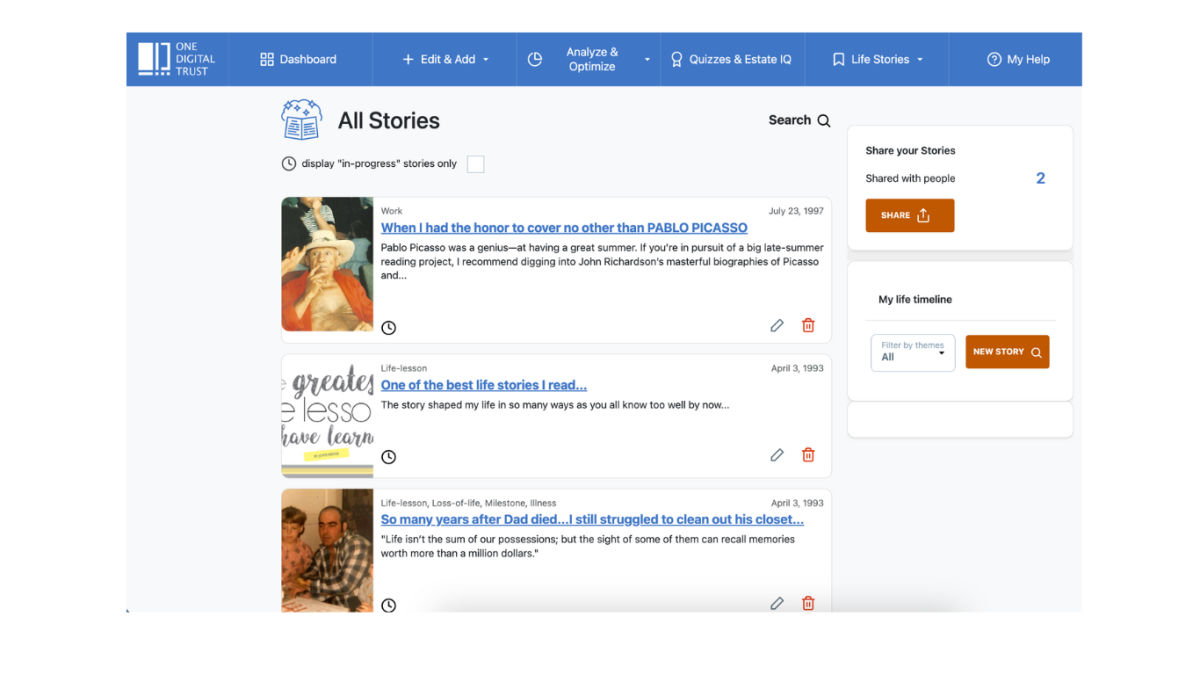
When discussing estate planning with clients and members, the focus often centers on assets, wills, and legal documents. However, the stories, values, and experiences that define their lives are equally important. Our estate planning platform’s Life Stories feature addresses this often-overlooked aspect of legacy planning, allowing your clients and members to capture and express bite-sized versions of key life experiences to share with future generations. 

A Window into Their World

The Life Stories feature enables your clients and members to create short narratives about their most memorable life experiences. But it doesn’t stop there. They can enrich these stories with audio, video, and images, bringing their memories to life in vivid detail. Your clients and members can share amazing memories such as:

  • The story of how they met their spouse, complete with a recording of their favorite song
  • A recounting of their proudest achievement, accompanied by photos of the event
  • The history behind a family heirloom, showcased in a video with a detailed explanation of its significance

These multimedia stories create a rich, immersive experience for their loved ones, allowing them to connect with these memories on a deeper level.

Why Sentimentality Matters in Estate Planning

In traditional estate planning, sentimentality is often overlooked, yet it’s this emotional connection that truly resonates with heirs. Encouraging the expression of sentimentality is essential because these stories, values, and emotions transform an estate plan from just a set of legal documents into a cherished legacy. When individuals preserve these priceless memories, they’re not just protecting their history—they’re strengthening emotional bonds. As a financial advisor or institution, offering this opportunity sets you apart, demonstrating a deep commitment to the emotional and financial well-being of those you serve. This deeper connection enhances your service, strengthening relationships and bolstering your brand’s reputation.

A Digital Altar for Immortalizing Memories

The OneDigitalTrust platform is uniquely equipped to help achieve this sentimentality through an integrated feature that serves as a digital altar—a memorial where memories are immortalized. It’s more than just a repository for stories; it’s a sacred space where legacies live on, accessible to future generations. This exclusive capability transforms estate planning into a deeply personal experience for your clients and members, ensuring that stories, values, and emotions are preserved in a meaningful and lasting way.

Beyond Assets: The Value of Values

While financial assets are undoubtedly crucial, the true essence of estate planning lies in preserving and transmitting values, wisdom, and life lessons. The Life Stories feature helps clients and members to:

  1. Provide context: Stories can explain the reasoning behind certain financial decisions or bequests, helping heirs understand these choices.
  2. Share wisdom: Life advice, family traditions, or personal philosophies that have guided someone can be passed down.
  3. Preserve family history: Anecdotes about ancestors or family lore that might otherwise be lost to time can be recorded.
  4. Express love and appreciation: Messages can be left for loved ones, sharing feelings and the impact these individuals have had.
  5. Inspire future generations: Stories of perseverance, achievement, or personal growth can motivate and guide descendants.

Sentiments Enrich Estate Planning

While the traditional elements of estate planning remain vital, the sentimental aspect should not be underestimated. Personal stories are the threads that weave together the tapestry of a client’s life, and sharing them is perhaps the most precious legacy they can leave behind.

The Life Stories feature on the OneDigitalTrust platform makes it easy for your clients and members to capture, enrich, and share these invaluable memories, ensuring that their values, experiences, and wisdom live on for generations. By offering this unique, integrated service, your firm not only elevates its offerings but also strengthens client relationships, positioning you as a leader in comprehensive and compassionate estate planning.

Categories
Blog

Why Executors & Advisors need to be concerned about undue Influence leading to (financial) elder abuse

The Problem

The population in the U.S. is aging rapidly with the 65+ age group poised to double within the next 20 years. An unwanted, yet invariable side-effect is that the occurrences of (financial) elder abuse will also experience a remarkable increase. As the level of incapacity progresses among the seniors in our population they become more vulnerable to undue influence leading to financial elder abuse. An example is – dementia. With 10 million people suffering every year from symptoms including memory loss, diminished decision-making and trouble communicating, dementia is robbing our older population of both their daily functioning and their agency. Already, a massive demographic of citizens are vulnerable to undue influence. This concerning trend sets the groundwork for a deeper look into  “undue influence”, and how it affects incapacitated people.

What is “Undue Influence”?

Undue influence does not have a one size fits all definition. However, in every situation involving undue influence, common elements emerge: an incapacitated person, unable to make their own decisions, maintains a close relationship with an individual who possesses some level of authority over them. This enables them to make decisions on the incapacitated person’s behalf and ultimately manipulate the situation for their own benefit. 

In a legal sense, some states define undue influence as when a fiduciary or confidential relationship exists in which one person substitutes his own will for that of the influenced person’s will. This usually occurs when a mentally or physically incapacitated person creates their will before their health issues begin, and someone convinces them to change their wishes after they are incapacitated. This could happen when a family member isolates the incapacitated person from other relationships, influencing them to distrust others and eventually pressures them to make certain decisions that they wouldn’t make if not persuaded. However, Executors, Advisors and loved ones can do their part to ensure that the wishes of the incapacitated person are being respected and carried out.

What can financial advisors and executors do?

Executors and Advisors should be aware that the overwhelming majority of undue influence is motivated by family members seeking (financial) benefit from committing elder abuse – children and spouses/partners may often be the key offenders. As a financial advisor or an executor for someone beginning to show signs of incapacity, which is preventing them from making their own decisions, it’s important to be aware of the threat of undue influence. An example is – to notice when the person has become highly dependent on a specific person for help with daily functioning, emotional or financial decision-making. Also, be aware if this specific person is seemingly always supervising or accompanying them in a way that seems to be allowing the person to exert control. These could be red flags that undue influence can occur shortly, if not already.

There are measures that can be taken to prevent your client or loved one from becoming a victim of it. Financial advisors could leverage a comprehensive estate planning platform to properly document their incapacitated client’s wishes and financial goals that were discussed when they were still able to make their own decisions. Both financial advisors and executors of incapacitated individuals should be watchful for repeated signs of growing incapacity – memory, hygiene, judgment, mood among other factors and maintain consistent communication with the incapacitated person’s family members and trusted caregivers to watch for any signs of undue influence. 

How “smart” digital platforms can help

Another key observation is that prior to the introduction of online estate & inheritance planning platforms, undue influence was much harder to commit. It could take a long time to convince an incapacitated person to change their mind about their wishes and then visit the  attorney’s office to  get a modified will drawn up. In this new age of all-digital technology, online estate planning platforms make it simple and affordable for users to create estate plans and make unlimited changes (small and large) rapidly. 

As a result, it’s more important than ever for such digital technology platforms to embed “smart” safeguards to uncover and detect undue influence from becoming more commonplace for our elderly population. 

To prevent (financial) elder abuse from occurring in the first place, Executors, Advisors and loved ones are required to develop heightened awareness to safeguard seniors as they detect signs of oncoming incapacity. The Advisor Portal from OneDigitalTrust leverages “smart” technology to notify Advisors in cases where high(er) characteristics of (financial) elder abuse may exist. 

Schedule a demo to see the OneDigitalTrust  Advisor Portal in action. 

By Alia Hardy
Customer Success Team

Categories
Blog

Preserving Trust and Legacy: The Vital Role of Estate Planning for Financial Advisors

For financial advisors, one truth stands out above all others–trust is paramount. Clients entrust their financial legacies to you, and it’s your responsibility to guide them in safeguarding their family’s future. A profound way to foster trust and demonstrate commitment is by helping clients develop and comprehend estate planning strategies. This blog post will explore how financial advisors can leverage estate planning to build trust and preserve their clients’ family legacies for generations.

The Essence of Estate Planning for Advisors

Estate planning extends beyond drafting wills or creating trusts. It’s a fundamental component of comprehensive financial planning that transcends age, income, and net worth. At its core, estate planning involves creating a structured strategy to manage assets, minimize taxes, and ensure the seamless execution of clients’ wishes following their passing.

For financial advisors, estate planning is not just a service but a way to underscore your commitment to your clients’ long-term financial security while helping them ensure their assets end up where intended. Estate planning allows you to empower your clients with knowledge and expertise, helping them make informed decisions about their financial legacies.

1. Understanding Clients’ Aspirations and Goals

Building trust begins with meaningful conversations to help you understand your clients personally and financially. Take the time to learn about their unique aspirations, concerns, and values. Some key aspects to explore include:

  • Asset Distribution: Identify their preferences regarding the distribution of assets among heirs, charities, or other beneficiaries.
  • Tax Efficiency: Discuss strategies for minimizing estate taxes and preserving a more significant portion of their wealth for their loved ones.
  • Guardianship: Address concerns related to guardianship and financial support for minor children or dependents.
  • End-of-Life Healthcare: Determine their healthcare directives, medical power of attorney, and preferences for medical decisions.

By actively listening and demonstrating empathy, you establish a foundation of trust that goes beyond mere financial advice.

2. Empowering Clients through Education

Estate planning can be complex, with various options and strategies to consider. As a trusted advisor, your role involves educating your clients so they can make informed decisions. Essential estate planning tools and techniques to discuss include:

  • Wills and Trusts: Clarify the significance of wills and trusts in specifying asset distribution and minimizing probate complexities.
  • Beneficiary Designations: Emphasize the importance of designating beneficiaries on financial accounts and insurance policies to streamline the asset transfer process.
  • Power of Attorney: Highlight the value of granting power of attorney to a trusted individual to manage financial and legal affairs if needed.
  • Healthcare Directives: Stress the importance of advanced healthcare directives to ensure their medical preferences are respected.
  • Tax Planning: Explore strategies like gifting, charitable giving, and other methods to reduce estate tax liabilities.

By providing clear explanations and guiding your clients through their estate planning options, you empower them to make decisions aligned with their family’s best interests.

3. Collaboration with Legal Experts

While you offer valuable insights into estate planning, it’s crucial to collaborate with legal professionals, such as estate planning attorneys, to ensure the legal soundness and comprehensiveness of your clients’ plans. Encourage your clients to consult legal experts who can draft documents and provide precise legal guidance.

By advocating a collaborative approach, you demonstrate your dedication to creating comprehensive and legal estate plans for your clients, further cementing their trust in your expertise.

4. Continuous Review and Adaptation

Estate planning is not a one-time task; it demands periodic review and adjustments. Encourage your clients to revisit their plans regularly, mainly when significant life events occur, such as marriages, divorces, births, or changes in financial circumstances. Offer your support during these reviews to ensure their estate plans remain relevant and effective.

Estate Planning for Advisors

As a financial advisor, your guidance through the intricacies of estate planning is a potent trust-building tool. By comprehending your clients’ goals, educating them on their options, collaborating with legal experts, and providing ongoing support, you help clients preserve their family’s legacy and confirm your unwavering commitment to their financial well-being. Through this commitment, you build trust and guarantee a lasting legacy for generations to come—a legacy that reflects your dedication and expertise as a trusted advisor.

Is your firm ready to incorporate cutting-edge, turn-key technologies into your financial planning process? Get started today, and register for your free Advisor Portal!

Categories
Blog

How Financial Institutions & Advisors Use Estate Planning Services to Grow Their Business

As the number of people searching for estate planning guidance is on the rise, trusted financial advisors, like credit unions, banks and advisory firms, looking to impact the growth of their businesses are seeking partnerships with the best estate planning software providers. Adding estate and inheritance planning to your portfolio will position your organization as the go-to source for financial guidance and unlock new revenue and business expansion avenues. In this article, we’ll discuss three ways estate planning software for financial advisors can help your firm grow and thrive.

1. Streamline Business Operations

Efficiency is the bedrock of any thriving business, and financial institutions and advisory firms are no exception. Estate planning software solutions that offer an all-inclusive estate and inheritance platform for advisors to invite customers to create and manage their own end-of-life documents can be a game-changer by adding new sources of income while streamlining your business processes:

  • Document Management: Traditional estate planning often involves an overwhelming amount of paperwork. Utilizing one centralized estate planning platform allows you to digitize and centralize all client documents in a secure online repository –reducing the risk of document loss or misplacement and allowing for swift and easy retrieval when needed.
  • Workflow Automation: Repetitive tasks like document generation, appointment scheduling, and client reminders can consume a significant portion of your staff’s time. Estate planning solutions that optimize business processes free up valuable time and resources that can be redirected toward more client-focused activities.
  • Compliance Assurance: Regulatory compliance is non-negotiable in the financial sector. The best estate planning software often comes equipped with built-in compliance features, helping your firm stay on the right side of the law. This mitigates potential risks and enhances your reputation as trustworthy and compliant.

2. Nurture Client Relationships

Relationships are the lifeblood of any financial institutions or advisory firm. Comprehensive estate planning can play a pivotal role in nurturing and deepening these relationships:

  • Personalized Planning: End-of-life preparation is a deeply personal and emotional process for clients. Estate planning software allows you to deliver a more personalized experience and guarantee the highest level of financial guidance while tailoring your services to each client’s unique needs and circumstances. This level of personalization fosters trust, enhances client satisfaction, and helps cultivate authentic connections.
  • Improved Communication: Effective communication is key to maintaining strong relationships. Estate planning platforms often include communication tools such as secure messaging and notifications. These features enable you to easily stay in touch with your clients, providing updates, answering queries, and addressing concerns promptly.
  • Collaborative Planning: Collaborative planning is made easier with estate planning software. You and your clients can work together on their estate plans in real time, fostering a sense of partnership and shared responsibility. Clients appreciate the transparency and involvement in this crucial aspect of their financial future.

3. Embrace Tech-Driven Solutions

Consumers expect their banks, credit unions and financial advisors to embrace technology and seek convenient, all-digital services. Leading estate planning software and platforms designed for institutions and advisory firms enable your team to do just that:

  • Competitive Edge: Offering cutting-edge technology solutions sets your firm apart. Consumers are more likely to choose a financial advisor who uses modern tools and software to enhance their services and the client experience. 
  • Remote Accessibility: Estate planning software is often cloud-based, allowing you and your clients to access and update their plans from anywhere with an internet connection. This flexibility is especially valuable in an increasingly remote and mobile world.
  • Data Security: The sensitive nature of estate planning data requires top-notch security. Reputable estate planning software providers invest heavily in data security measures, ensuring your client’s information remains confidential.

The Best Estate Planning Software

Seizing opportunities for growth and expansion is paramount to success. Estate planning platforms can be a powerful ally in achieving these goals. With OneDigitalTrust’s award-winning estate planning platform and Advisor Portal, you can streamline business processes, nurture long-term client relationships, and embrace tech-driven solutions to help your firm stay ahead of the curve and position itself for long-term success in a competitive marketplace. Contact our team today to learn more about digital estate and inheritance planning and how you and your clients can benefit!

Categories
Blog

From Pixels to Prosperity: How Financial Advisors Level Up With Estate Planning

How Financial Advisors Can Enhance Their Digital Footprint

Establishing a strong online presence is paramount for financial advisors seeking to expand their reach and grow their client base. Leveraging estate planning services can be a game-changer in boosting your digital footprint and attracting prospective clients. In this blog, we will explore how financial advisors can enhance their digital footprint by harnessing the power of estate planning to enhance their online visibility, credibility, and, ultimately, their business success.

1. Establish Expertise Through Valuable Content

Estate planning is a complex and critical aspect of financial advising, and clients are actively seeking knowledgeable professionals to guide them through the process. Create a content-rich blog on your website covering various estate planning topics, including wills, trusts, estate tax, and asset distribution. Offer valuable insights and practical advice to demonstrate your expertise and establish trust with your online audience.

2. Utilize Social Media to Engage and Educate

Social media platforms provide an excellent avenue for financial advisors to engage with potential clients and showcase their ability and excitement to offer estate planning services. Create compelling posts, infographics, and videos highlighting the importance of creating and maintaining a legally-valid estate plan and its long-term effect on their family’s financial security. Share success stories of clients who have benefited from your guidance, and encourage followers to ask questions or seek advice. Consistent and informative social media activity can significantly boost your online visibility and credibility.

Subscribe To Our Newsletter


3. Craft a Well-Designed Website

A professional, user-friendly website is your virtual storefront and a crucial element of your digital footprint. Ensure your website is visually appealing and provides comprehensive information about your estate planning services. Optimize the site for search engines, making it easier for potential clients to find you when searching for estate planning advice. Incorporate clear calls to action, encouraging visitors to contact you for further assistance.

4. Harness the Power of Search Engine Optimization (SEO)

SEO is a fundamental aspect of increasing your digital footprint. Optimize your website and content with relevant keywords related to estate planning. Conduct keyword research to understand what your target audience is searching for, and tailor your content accordingly. You can attract more organic traffic and potential clients to your website by ranking higher in search engine results.

5. Showcase Testimonials and Client Reviews

Testimonials and client reviews can significantly impact your online reputation and trustworthiness. Encourage satisfied clients to share their experiences on your website or reputable review platforms. Positive feedback from real clients adds authenticity to your service offerings, encouraging others to seek your guidance.

6. Host Webinars and Virtual Events

Host webinars and virtual events around your firm’s service offerings while highlighting your newly augmented estate planning services to increase your digital footprint. Invite industry experts and professionals to join these events, providing valuable insights and fostering community among attendees. Webinars can serve as an opportunity to showcase your expertise while attracting potential clients interested in estate planning solutions.

7. Collaborate with Influencers and Partners

Partnering with influencers or industry experts in related fields can widen your digital reach and introduce your estate planning services to new audiences. Look for opportunities to contribute guest posts to reputable financial and estate planning publications. Seek partnerships with companies that provide estate planning software that allows you to provide your clients with the best estate planning solution and minimize risk. Engaging in strategic collaborations to provide comprehensive, all-digital estate planning capabilities can enhance credibility and establish your firm as a go-to resource for estate planning expertise.

How Financial Advisors Can Enhance Their Digital Footprint – Conclusion 

Incorporating estate planning services into your digital strategy is an exciting move for financial advisors seeking to increase their online presence and expand their client base. By sharing valuable content, utilizing social media, optimizing your website, and building a strong online reputation, you can leverage estate planning to grow your digital footprint and elevate your financial advisory firm to new heights of success. Embrace the digital landscape, and watch as your estate planning services pave the way for lasting growth and client trust. Want to learn more about how you can effortlessly incorporate estate planning into your service offerings? Contact us today! 

Looking for more ways to solidify client relationships, increase revenue streams, and establish yourself as an essential part of your client’s financial future? Download our free guide! 

Financial Advisor Marketing Guide