Announcing our SOC2 Type 2 Compliance.
Categories
Blog INSIGHTS

National Make-A-Will Month: Dispelling Myths and Strengthening Client Relationships

For financial advisors and financial institutions, National Make-A-Will Month offers a unique opportunity to deepen client and member relationships, provide valuable guidance, and enhance your brand by incorporating estate planning into your services. With our Financial Advisor portal, you can easily guide clients through the estate planning process, helping them create or update their Wills. This not only strengthens your relationships but also positions you as a comprehensive financial advisor. With 68% of Americans without a Will, this month serves as a reminder to your clients and members to take action.

Myth: Only the Wealthy Need Estate Plans

Reality: Estate planning is essential for clients and members at all income levels. Advising clients and members to protect their assets, no matter the size, ensures their wishes are honored and legal complications are minimized.

Myth: Estate Planning Is a One-Time Event

Reality: Clients and members often think estate planning is a once-and-done task. In reality, it requires ongoing review and updates as life circumstances change, such as marriage, divorce, or the acquisition of new assets, etc.

Myth: Estate Planning Has to Be Expensive

Reality: With the OneDigitalTrust platform, we offer comprehensive estate planning to your clients and members without the hefty price tag. With transparent costs and a user-friendly interface, we can ensure they will get the best value for their investment.

Myth: Clients Don’t Ask Advisors About Estate Planning

Reality: Research shows that 93% of clients expect estate planning advice from their financial advisor, but only 22% receive it. Also, 66% of children change financial advisors after inheriting wealth. OneDigitalTrust strengthens client relationships and uncovers new opportunities.

As we observe National Make-A-Will Month, it’s the perfect time to reinforce the importance of estate planning to your clients and members. By dispelling myths and offering accessible, effective solutions like the OneDigitalTrust platform, you can help ensure that everyone, regardless of wealth or stage in life, has a plan in place. Let’s use this opportunity to build stronger, more informed relationships with those we serve, and make a meaningful impact on their financial well-being.

Categories
Blog INSIGHTS

How the financial advisory space has evolved

By Guest Blogger Doug Trott, director & advisor to SaaS and fintech firms

Well, I have been advising wealth management businesses ranging from discount brokerage to private banking for more than three decades now.

One of the most significant changes, indeed, pressures on the financial advisory space has been the advent and success of self-directed, typically discount, brokerage offerings. This may seem like ‘old news,’ but the effects on the industry and investors have been profound and unfolded over decades.

As retail investors became empowered by firms like Schwab and Fidelity, their expectations around value for fees from advisors increased substantially. With the subsequent introduction of the internet, investors could conduct investment research and analysis, compare alternative investments and ideas, and construct portfolios, which had historically been the purview of financial advisors.

Second, the ‘advertised’ price of trades caused many investors to question the cost of investment services delivered by advisors, leading to fee compression and a need to upskill advisors. During this period, mutual funds exploded in popularity and adoption, soon followed by exchange-traded funds.

These developments empowered investors, increased their investment choices, and reduced their investment costs. Advances in technology not only empowered investors but also further empowered advisors. Most recently, the introduction of managed ETF portfolios and then robo-advisors further broadened investor choice and lowered the reference price of investments, amounting to further price pressure on advisors.

As these fundamental changes occurred, advisor business models began to shift, with firms like LPL and other ‘independents’ enabling advisors to effectively rent a leading-edge technology platform and operate as their own business, defining their individual service offering, product ranges and price levels. As a consequence, there has been a steady shift of advisors from employed advisors to independent advisors. At the same time, the industry as a whole sees few firms hiring and training new advisors, so the pool is shrinking as advisors retire.

Where people get their financial advisory services

A positive outcome of the growth of tech platform availability has been the empowerment of credit unions and community banks to provide competitive investment offerings to their members and clients, representing an increase in competition.

We have also witnessed the steady introduction of regulations designed to protect retail investors, many of which have the unintended consequence of burdening firms and advisors and representing significant demands on the time and capacity of advisors to remain compliant. Many would argue that retail clients are better protected but at a cost reflected in the increased expense of investment delivery and the compression of time available for advisors to serve their clients.

Product innovation has accelerated with the gradual adoption of alternative investments and digital assets, changing the complexion of investment portfolios and introducing new demands on advisors.

Lastly, and most recently, the advent of tech solutions that enable ‘hyper-personalization’ has improved the nature of the client relationship, shifting from one-size-fits-all to customized plans and even service models.

To be sure, the financial advice industry has evolved mainly for the betterment of retail investors. Their product choice has broadened. They can choose to be self-directed, advised or both. They can choose from a wide range of low-cost to full-service offerings, and their regulatory protections have increased. Indeed, one could argue they now suffer from too much choice and too much protection.

The confluence of COVID-19

The COVID-19 pandemic was a massive jolt to the industry. Uncertainty after the S&P declined 19.4% at the start of the pandemic had clients asking questions and advisors overwhelmed by those seeking answers to the risk they were now experiencing. To compound matters, face-to-face meetings became extinct quickly, precipitating clients’ adoption of digital communication methods faster than advisors, their firms and regulators had ever contemplated.

After enabling remote work and catching up to client digital expectations, financial advice firms invested in creating fully digital experiences and redesigning their compliance processes to accommodate a new service experience. The financial planning market – long considered a paper-document-heavy, arduous, unpleasant experience where more than half of clients failed to complete what they and their advisor started – was rejuvenated by dozens of innovative new tech firms that launched digital-first applications designed to be client – rather than output – centric.

COVID-19 also got people thinking about mortality and estate planning

The pandemic also increased the propensity of clients to consider end-of-life planning as loved ones faced the risk of prolonged illness or even death.

Lately, executives and individual advisors have become increasingly concerned as they appreciate the import of a looming asset transition among family members. Historical experience has shown that when a client dies, and their estate is administered, the heirs and beneficiaries most typically exit the incumbent advisor relationship, thereby reducing their assets under administration and earnings stream.

Over the last few years, a shift has occurred to discard the notion that this attrition is unavoidable and that there is a payoff to becoming proactive about advice delivery beyond the lifespan of the individual client. Pundits hypothesize that the causes of the attrition are a lack of advisor familiarity with the heirs and beneficiaries, non-involvement with the estate administration, and unintended exclusion of heirs and beneficiaries from the client relationship.

In response, advisors have increasingly sought methods to address these causes, largely to become more fully aware of the estate and its heirs and beneficiaries and be regarded as a resource by those constituents. OneDigitalTrust allows financial advisors to see more deeply into clients’ complete financial assets, including those held elsewhere, and the beneficiaries to begin to develop an ongoing relationship with them far into the future.

Historically, advisors referred their clients with more complex and large potential estates to local attorneys or in-house trust departments in the case of wire houses and banks. They often lost control and visibility of the process and the likely outcomes. These referrals typically represent less than 10% of the clients; the rest of their clients remained in an ambiguous state – attorneys were too costly, and they were considered too small to be served by internal trust departments.

Fintech to the rescue

Enter financial technology innovators to address the question: How do we use technology and scale to generate cost-effective estate documents and advisor visibility for advisors’ unserved clients? Fintechs have invested substantial capital into designing processes and easy-to-use software that simplifies the process, customizes it for all legal jurisdictions, and enables advisors to collaborate with their clients instead of referring them ‘out of house’ all the while safeguarding that there is no “unauthorized practice of law.”

Clients who lack estate plan documents can now build confidence that their plans and wishes are documented and stored in a secure digital vault, that they will be alerted to any changes that require changes, and that their documents will be readily accessible to their estate plan executors, all at a reasonable cost.

Clients with estate documents can benefit from the digital vault and change-required alerts. Advisors gain full visibility into the estate components, deepen their client relationships, become relevant to the future heirs and beneficiaries, enable an efficient periodic estate review, and add a new revenue stream to their business.

The OneDigitalTrust platform’s simple user interface and guidance ensures an individual’s estate is optimized for probate, delivering the most value to the family. And, finally, we pass on so much more than money: Whether it’s your grandad’s life story or your great aunt’s chicken soup recipe, it can be passed down along their the decedent’s possessions with OneDigitalTrust.

By adding estate planning to their services, financial advisors:

  • Gain complete visibility into the financial and non-financial assets of the client
  • Enable relevant engagement with future heirs, beneficiaries, and executors, thereby reducing the prospect of future attrition
  • Add a tech-enabled touchpoint with clients to review the estate plans’ currency and affect any changes required
  • Add a new recurring revenue stream to their practice

In the words of Nike, “Just do it!”

Categories
Blog INSIGHTS

Empowering Clients by Anticipating the Need for Third-Party Executors in Estate Planning

On July 21, 2023, Grammy award-winning singer Tony Bennett passed away. He was survived by his four children: Danny, Dae, Antonia and Johanna. Upon his death, the Family Trust directed that the “tangible personal property is to be distributed in equal shares” to his four children per the father’s estate plan.

Bennett’s eldest son, Danny, was designated as the trustee for the Family Trust. He stated the value of the estate at slightly less than $7 million.

Quite to the contrary, a lawsuit filed by Antonia and Johanna Bennett alleges that Tony Bennett’s estate is valued at more than $100 million. The sisters are accusing their brother of deliberately hiding the estate’s true value. Generally, in such scenarios, a third-party executor—someone who is neutral and not emotionally invested—could have helped avoid this family conflict.

In many situations, family members may not make the best executors

One of the most critical decisions you’ll make in estate planning is choosing an executor for your will. Estate planning can be incredibly messy, especially when a large sum of money is involved.While many people instinctively select a family member for this role, there are compelling reasons to consider a third-party executor. This choice can be vital for preserving family harmony and ensuring your final wishes are carried out effectively, without bias. By opting for a third-party executor or even a professional executor, your clients’ families should be able to grieve the loss of your loved one without worry that an inheritor is going to make a power play for money.

Understanding the role of the executor

The executor’s role is both crucial and potentially challenging. The responsibilities include:

  • Listing all forms of assets and debts of the estate
  • Ensuring all of the deceased’s debts have been paid
  • Publishing an official notice to creditors
  • Fulfilling legal obligations in meeting the wishes of the deceased
  • Notifying the necessary agencies and administrations, such as the Internal Revenue Service and the Social Security Administration

While these duties can be deferred to an estate attorney, it’ll likely be expensive and reduce the estate’s assets.

The benefits of a professional executor

When a large or complex estate is involved, hiring a professional executor may be a preferred course of action for many reasons.

First, as is evident in the Tony Bennett case, is reducing family conflict. By removing a family member from the decision-making process, you minimize the risk of perceived favoritism or attempts to secure a larger portion of the funds.

Second, excluding a family member from a financial advisory client’s estate plan can create awkward scenarios. Whether done punitively or for other reasons, this becomes especially problematic when another relative acts as executor. A third-party executor has no emotional stake in family dynamics, allowing them to focus solely on efficiently settling the estate and carrying out their duties.

These scenarios are best dealt with by professionals who can neutrally mediate heated and intensely emotional situations. Additionally, professional third-party executors are held to rigorous standards and are usually insured, which mitigates liability and offers a level of expertise that a family member acting as an executor may lack.

Ensure clients understand an executor’s liabilities

According to Alma Banuelos, Head of Trust and Estate Services at City National Bank, “You are 100% liable for all acts and omissions, which means you could personally be sued if something goes wrong, the beneficiaries are unhappy with your decisions and/or you make a mistake that costs the estate money.”

Family members may not have the necessary legal and financial knowledge to handle complex estate matters effectively. Serving as an executor is an immense legal responsibility to put on a loved one who likely has no experience dealing with settling estates.  An external executor can provide the neutrality, expertise, and professionalism needed to navigate complex family dynamics and ensure your wishes are carried out faithfully.

Choosing an executor is a highly personal decision. The OneDigitalTrust platform simplifies this process by allowing you to assign a third-party service as an executor. Additionally, you can specify in your documents that you want your executor to be compensated for their services, ensuring fair treatment for the crucial role they play in settling your estate. When family conflict is a concern, opting for a third-party executor can be a proactive step towards not just protecting your estate but also leaving a positive legacy for your loved ones.

170M Americans need an estate plan. OneDigitalTrust offers a white-label, turnkey estate planning platform with pricing options tailored to the needs of individual credit unions and financial advisors.

Contact us today to learn more!

Categories
Blog INSIGHTS

A New Partnership To Enable Immediate Liquidity For End-of-Life Expenses From Within The OneDigitalTrust Platform

Summary

Despite careful planning, surviving family members may face thousands of dollars in expenses while waiting to obtain the death certificate in order to access inherited funds. The new strategic partnership and integration of the innovative Beneficiary Liquidity Plan® (BLP) with the OneDigitalTrustTM estate planning platform, creates an embedded digital capability to overcome this critical gap in traditional estate planning: ensuring immediate financial support for loved ones in the wake of a loss. This new partnership, expands the comprehensiveness of OneDigitalTrustTM in setting a new standard for holistic end-of-life financial preparation.

The Need

With this capability embedded in the OneDigitalTrustTM platform, any customer, member or employee using the platform can allocate funds that their beneficiaries will receive within 24 – 48 hours of death. This tackles a widespread problem that often goes unaddressed in conventional estate planning. Studies show that more than 50% of families report going into debt following the loss of a loved one, often resorting to credit cards or depleting personal savings to cover immediate and necessary expenses. This financial strain adds unnecessary stress to an already emotionally challenging time.

The OneDigitalTrustTM platform enhanced by BLP, allows users to proactively provide for a range of post-death expenses. These may include – funeral costs and celebrations of life, travel expenses for loved ones to pay their respects, essential mortgage and utility payments, outstanding medical bills that could otherwise burden the estate, and legal fees associated with estate settlement. By addressing these time-sensitive financial needs, this new capability ensures that beneficiaries can focus on grieving and honoring their loved one’s memory, rather than grappling with financial stress during an already difficult time.

How It Works

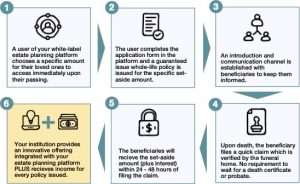
When you offer your clients, members, customers or employees the OneDigitalTrustTM  estate planning platform, branded as your own, any user can choose to opt-in by clicking on a link and completing a simple application form, while being assured of the following:

  • Guaranteed issue whole life policy *
  • No health questions
  • No medical exam or tests
  • No required ongoing premium payments
  • PLUS, BENEFICIARY ACCESS TO POLICY FUNDS WITHIN 24-48 HOURS

Once submitted, the application is reviewed and a single premium, whole life insurance policy is issued for an amount as chosen by the user. The policies are issued by Homesteaders Life Insurance Company, who works directly with any licensed funeral homes across the country to complete the claims process. When the beneficiaries of any user file their claim through a licensed funeral provider, the funds are disbursed within 24 – 48 hours.

As a result, there is no need to wait for a copy of the official death certificate to access inherited funds which can take 4 – 6 weeks after requesting from The Department of Health & Human Services (DHHS). Plus, the time to submit the death certificate and file the claim with the financial institution holding the funds, can realistically add another 3 – 4 weeks.


A User-Specified Amount Disbursed To Beneficiaries Within 24-48 Hours of Death To Cover Essential End-of-Life Expenses


For Financial Advisors

The integration of BLP into the OneDigitalTrustTM platform offers a particularly powerful tool to strengthen client relationships and extend them to the next generation – a crucial aspect of long-term practice management. By offering this comprehensive solution, advisors can demonstrate their commitment to clients’ long-term financial well-being, even beyond their lifetime. This approach may also help mitigate situations where beneficiaries might face frustrating delays in accessing inherited funds, potentially blaming the advisor for circumstances beyond their control. Further, this new capability serves as an excellent conversation starter for advisors and allows them to broach the often-sensitive topic of estate planning in a constructive manner, highlighting the practical benefits of immediate liquidity for beneficiaries. This can lead to more comprehensive financial planning discussions and potentially uncover additional planning needs or opportunities to serve the client.

The OneDigitalTrustTM platform, bolstered by BLP, truly serves as the final piece of a robust financial plan. It creates a bridge between generations, ensuring that an individual’s financial legacy translates into immediate support for their beneficiaries.

For Institutions

Now institutions can go even further than offering an essential and affordable digital estate planning platform to their members, customers and employees. With the BLP integration, the white-label OneDigitalTrustTM platform can provide stakeholders with an unprecedented level of control over their legacy. This allows users to extend their care and support for loved ones beyond their lifetime, ensuring that their passing doesn’t create undue financial hardship. This capability adds even more peace of mind to customers, members and employees, knowing that even in death, they can still provide for their family’s immediate needs. By offering this innovative capability, pre-integrated into the OneDigitalTrustTM platform, extends the comprehensiveness of the platform to new heights by offering peace of mind and financial security that goes well beyond an individual’s lifetime, truly connecting generations through thoughtful financial planning.

This new capability represents a significant step forward in digital estate planning, acknowledging that a comprehensive plan must address not only the long-term distribution of assets but also the immediate financial needs that arise upon a person’s passing. Institutions can garner the following benefits:

  • Further augment personal & family wellness
  • Amplify brand-loyalty through an affordable & comprehensive platform-offering
  • Generate revenues from platform subscription PLUS insurance commission

Conclusion

The integration of the Beneficiary Liquidity Plan® (BLP) into the OneDigitalTrustTM platform marks a significant evolution in digital estate planning. It addresses a crucial need that has long been overlooked in traditional estate planning approaches, providing immediate financial support to beneficiaries when they need it most. For financial advisors, it offers a powerful tool to enhance their service offerings and strengthen multi-generational client relationships. For institutions, it equips them to deliver even more peace of mind to their customers, members and employees by providing them with a tangible way to care for loved ones even after they’re gone. As the financial planning landscape continues to evolve, innovations like this set a new standard for comprehensive, thoughtful, and truly impactful digital estate planning.

⎯⎯⎯⎯⎯⎯⎯⎯⎯⎯⎯⎯⎯⎯⎯⎯⎯⎯⎯⎯⎯⎯⎯⎯⎯⎯⎯⎯⎯⎯⎯⎯⎯⎯⎯⎯⎯⎯⎯⎯⎯⎯

The Beneficiary Liquidity Plan® (BLP) was founded by industry experts with decades of experience in working with top financial advisors. They recognized the need for an innovative solution to help individuals provide their loved ones with quick, easy access to funds following their death and enable advisors to build and maintain relationships with their clients’ beneficiaries.

Insurance policies under the plan are funded by Homesteaders Life Company, a mutual company and national leader in providing products and services to promote and support the funding of end-of-life expenses.