

By Guest Blogger Doug Trott, director & advisor to SaaS and fintech firms
Well, I have been advising wealth management businesses ranging from discount brokerage to private banking for more than three decades now.
One of the most significant changes, indeed, pressures on the financial advisory space has been the advent and success of self-directed, typically discount, brokerage offerings. This may seem like ‘old news,’ but the effects on the industry and investors have been profound and unfolded over decades.
As retail investors became empowered by firms like Schwab and Fidelity, their expectations around value for fees from advisors increased substantially. With the subsequent introduction of the internet, investors could conduct investment research and analysis, compare alternative investments and ideas, and construct portfolios, which had historically been the purview of financial advisors.
Second, the ‘advertised’ price of trades caused many investors to question the cost of investment services delivered by advisors, leading to fee compression and a need to upskill advisors. During this period, mutual funds exploded in popularity and adoption, soon followed by exchange-traded funds.
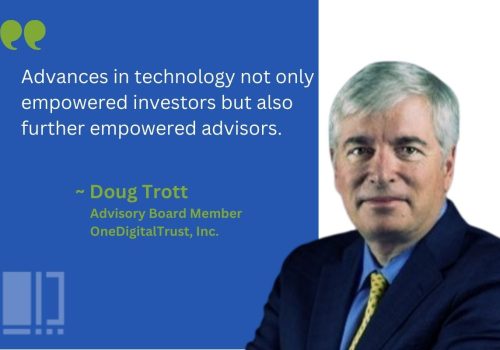
These developments empowered investors, increased their investment choices, and reduced their investment costs. Advances in technology not only empowered investors but also further empowered advisors. Most recently, the introduction of managed ETF portfolios and then robo-advisors further broadened investor choice and lowered the reference price of investments, amounting to further price pressure on advisors.
As these fundamental changes occurred, advisor business models began to shift, with firms like LPL and other ‘independents’ enabling advisors to effectively rent a leading-edge technology platform and operate as their own business, defining their individual service offering, product ranges and price levels. As a consequence, there has been a steady shift of advisors from employed advisors to independent advisors. At the same time, the industry as a whole sees few firms hiring and training new advisors, so the pool is shrinking as advisors retire.
Where people get their financial advisory services
A positive outcome of the growth of tech platform availability has been the empowerment of credit unions and community banks to provide competitive investment offerings to their members and clients, representing an increase in competition.
We have also witnessed the steady introduction of regulations designed to protect retail investors, many of which have the unintended consequence of burdening firms and advisors and representing significant demands on the time and capacity of advisors to remain compliant. Many would argue that retail clients are better protected but at a cost reflected in the increased expense of investment delivery and the compression of time available for advisors to serve their clients.
Product innovation has accelerated with the gradual adoption of alternative investments and digital assets, changing the complexion of investment portfolios and introducing new demands on advisors.
Lastly, and most recently, the advent of tech solutions that enable ‘hyper-personalization’ has improved the nature of the client relationship, shifting from one-size-fits-all to customized plans and even service models.
To be sure, the financial advice industry has evolved mainly for the betterment of retail investors. Their product choice has broadened. They can choose to be self-directed, advised or both. They can choose from a wide range of low-cost to full-service offerings, and their regulatory protections have increased. Indeed, one could argue they now suffer from too much choice and too much protection.
The confluence of COVID-19
The COVID-19 pandemic was a massive jolt to the industry. Uncertainty after the S&P declined 19.4% at the start of the pandemic had clients asking questions and advisors overwhelmed by those seeking answers to the risk they were now experiencing. To compound matters, face-to-face meetings became extinct quickly, precipitating clients’ adoption of digital communication methods faster than advisors, their firms and regulators had ever contemplated.
After enabling remote work and catching up to client digital expectations, financial advice firms invested in creating fully digital experiences and redesigning their compliance processes to accommodate a new service experience. The financial planning market – long considered a paper-document-heavy, arduous, unpleasant experience where more than half of clients failed to complete what they and their advisor started – was rejuvenated by dozens of innovative new tech firms that launched digital-first applications designed to be client – rather than output – centric.
COVID-19 also got people thinking about mortality and estate planning
The pandemic also increased the propensity of clients to consider end-of-life planning as loved ones faced the risk of prolonged illness or even death.
Lately, executives and individual advisors have become increasingly concerned as they appreciate the import of a looming asset transition among family members. Historical experience has shown that when a client dies, and their estate is administered, the heirs and beneficiaries most typically exit the incumbent advisor relationship, thereby reducing their assets under administration and earnings stream.
Over the last few years, a shift has occurred to discard the notion that this attrition is unavoidable and that there is a payoff to becoming proactive about advice delivery beyond the lifespan of the individual client. Pundits hypothesize that the causes of the attrition are a lack of advisor familiarity with the heirs and beneficiaries, non-involvement with the estate administration, and unintended exclusion of heirs and beneficiaries from the client relationship.
In response, advisors have increasingly sought methods to address these causes, largely to become more fully aware of the estate and its heirs and beneficiaries and be regarded as a resource by those constituents. OneDigitalTrust allows financial advisors to see more deeply into clients’ complete financial assets, including those held elsewhere, and the beneficiaries to begin to develop an ongoing relationship with them far into the future.
Historically, advisors referred their clients with more complex and large potential estates to local attorneys or in-house trust departments in the case of wire houses and banks. They often lost control and visibility of the process and the likely outcomes. These referrals typically represent less than 10% of the clients; the rest of their clients remained in an ambiguous state – attorneys were too costly, and they were considered too small to be served by internal trust departments.
Fintech to the rescue
Enter financial technology innovators to address the question: How do we use technology and scale to generate cost-effective estate documents and advisor visibility for advisors’ unserved clients? Fintechs have invested substantial capital into designing processes and easy-to-use software that simplifies the process, customizes it for all legal jurisdictions, and enables advisors to collaborate with their clients instead of referring them ‘out of house’ all the while safeguarding that there is no “unauthorized practice of law.”
Clients who lack estate plan documents can now build confidence that their plans and wishes are documented and stored in a secure digital vault, that they will be alerted to any changes that require changes, and that their documents will be readily accessible to their estate plan executors, all at a reasonable cost.
Clients with estate documents can benefit from the digital vault and change-required alerts. Advisors gain full visibility into the estate components, deepen their client relationships, become relevant to the future heirs and beneficiaries, enable an efficient periodic estate review, and add a new revenue stream to their business.
The OneDigitalTrust platform’s simple user interface and guidance ensures an individual’s estate is optimized for probate, delivering the most value to the family. And, finally, we pass on so much more than money: Whether it’s your grandad’s life story or your great aunt’s chicken soup recipe, it can be passed down along their the decedent’s possessions with OneDigitalTrust.
By adding estate planning to their services, financial advisors:
- Gain complete visibility into the financial and non-financial assets of the client
- Enable relevant engagement with future heirs, beneficiaries, and executors, thereby reducing the prospect of future attrition
- Add a tech-enabled touchpoint with clients to review the estate plans’ currency and affect any changes required
- Add a new recurring revenue stream to their practice
In the words of Nike, “Just do it!”