Announcing our SOC2 Type 2 Compliance.
Categories
Blog INSIGHTS

National Make-A-Will Month: Dispelling Myths and Strengthening Client Relationships

For financial advisors and financial institutions, National Make-A-Will Month offers a unique opportunity to deepen client and member relationships, provide valuable guidance, and enhance your brand by incorporating estate planning into your services. With our Financial Advisor portal, you can easily guide clients through the estate planning process, helping them create or update their Wills. This not only strengthens your relationships but also positions you as a comprehensive financial advisor. With 68% of Americans without a Will, this month serves as a reminder to your clients and members to take action.

Myth: Only the Wealthy Need Estate Plans

Reality: Estate planning is essential for clients and members at all income levels. Advising clients and members to protect their assets, no matter the size, ensures their wishes are honored and legal complications are minimized.

Myth: Estate Planning Is a One-Time Event

Reality: Clients and members often think estate planning is a once-and-done task. In reality, it requires ongoing review and updates as life circumstances change, such as marriage, divorce, or the acquisition of new assets, etc.

Myth: Estate Planning Has to Be Expensive

Reality: With the OneDigitalTrust platform, we offer comprehensive estate planning to your clients and members without the hefty price tag. With transparent costs and a user-friendly interface, we can ensure they will get the best value for their investment.

Myth: Clients Don’t Ask Advisors About Estate Planning

Reality: Research shows that 93% of clients expect estate planning advice from their financial advisor, but only 22% receive it. Also, 66% of children change financial advisors after inheriting wealth. OneDigitalTrust strengthens client relationships and uncovers new opportunities.

As we observe National Make-A-Will Month, it’s the perfect time to reinforce the importance of estate planning to your clients and members. By dispelling myths and offering accessible, effective solutions like the OneDigitalTrust platform, you can help ensure that everyone, regardless of wealth or stage in life, has a plan in place. Let’s use this opportunity to build stronger, more informed relationships with those we serve, and make a meaningful impact on their financial well-being.

Categories
Blog INSIGHTS

How the financial advisory space has evolved

By Guest Blogger Doug Trott, director & advisor to SaaS and fintech firms

Well, I have been advising wealth management businesses ranging from discount brokerage to private banking for more than three decades now.

One of the most significant changes, indeed, pressures on the financial advisory space has been the advent and success of self-directed, typically discount, brokerage offerings. This may seem like ‘old news,’ but the effects on the industry and investors have been profound and unfolded over decades.

As retail investors became empowered by firms like Schwab and Fidelity, their expectations around value for fees from advisors increased substantially. With the subsequent introduction of the internet, investors could conduct investment research and analysis, compare alternative investments and ideas, and construct portfolios, which had historically been the purview of financial advisors.

Second, the ‘advertised’ price of trades caused many investors to question the cost of investment services delivered by advisors, leading to fee compression and a need to upskill advisors. During this period, mutual funds exploded in popularity and adoption, soon followed by exchange-traded funds.

These developments empowered investors, increased their investment choices, and reduced their investment costs. Advances in technology not only empowered investors but also further empowered advisors. Most recently, the introduction of managed ETF portfolios and then robo-advisors further broadened investor choice and lowered the reference price of investments, amounting to further price pressure on advisors.

As these fundamental changes occurred, advisor business models began to shift, with firms like LPL and other ‘independents’ enabling advisors to effectively rent a leading-edge technology platform and operate as their own business, defining their individual service offering, product ranges and price levels. As a consequence, there has been a steady shift of advisors from employed advisors to independent advisors. At the same time, the industry as a whole sees few firms hiring and training new advisors, so the pool is shrinking as advisors retire.

Where people get their financial advisory services

A positive outcome of the growth of tech platform availability has been the empowerment of credit unions and community banks to provide competitive investment offerings to their members and clients, representing an increase in competition.

We have also witnessed the steady introduction of regulations designed to protect retail investors, many of which have the unintended consequence of burdening firms and advisors and representing significant demands on the time and capacity of advisors to remain compliant. Many would argue that retail clients are better protected but at a cost reflected in the increased expense of investment delivery and the compression of time available for advisors to serve their clients.

Product innovation has accelerated with the gradual adoption of alternative investments and digital assets, changing the complexion of investment portfolios and introducing new demands on advisors.

Lastly, and most recently, the advent of tech solutions that enable ‘hyper-personalization’ has improved the nature of the client relationship, shifting from one-size-fits-all to customized plans and even service models.

To be sure, the financial advice industry has evolved mainly for the betterment of retail investors. Their product choice has broadened. They can choose to be self-directed, advised or both. They can choose from a wide range of low-cost to full-service offerings, and their regulatory protections have increased. Indeed, one could argue they now suffer from too much choice and too much protection.

The confluence of COVID-19

The COVID-19 pandemic was a massive jolt to the industry. Uncertainty after the S&P declined 19.4% at the start of the pandemic had clients asking questions and advisors overwhelmed by those seeking answers to the risk they were now experiencing. To compound matters, face-to-face meetings became extinct quickly, precipitating clients’ adoption of digital communication methods faster than advisors, their firms and regulators had ever contemplated.

After enabling remote work and catching up to client digital expectations, financial advice firms invested in creating fully digital experiences and redesigning their compliance processes to accommodate a new service experience. The financial planning market – long considered a paper-document-heavy, arduous, unpleasant experience where more than half of clients failed to complete what they and their advisor started – was rejuvenated by dozens of innovative new tech firms that launched digital-first applications designed to be client – rather than output – centric.

COVID-19 also got people thinking about mortality and estate planning

The pandemic also increased the propensity of clients to consider end-of-life planning as loved ones faced the risk of prolonged illness or even death.

Lately, executives and individual advisors have become increasingly concerned as they appreciate the import of a looming asset transition among family members. Historical experience has shown that when a client dies, and their estate is administered, the heirs and beneficiaries most typically exit the incumbent advisor relationship, thereby reducing their assets under administration and earnings stream.

Over the last few years, a shift has occurred to discard the notion that this attrition is unavoidable and that there is a payoff to becoming proactive about advice delivery beyond the lifespan of the individual client. Pundits hypothesize that the causes of the attrition are a lack of advisor familiarity with the heirs and beneficiaries, non-involvement with the estate administration, and unintended exclusion of heirs and beneficiaries from the client relationship.

In response, advisors have increasingly sought methods to address these causes, largely to become more fully aware of the estate and its heirs and beneficiaries and be regarded as a resource by those constituents. OneDigitalTrust allows financial advisors to see more deeply into clients’ complete financial assets, including those held elsewhere, and the beneficiaries to begin to develop an ongoing relationship with them far into the future.

Historically, advisors referred their clients with more complex and large potential estates to local attorneys or in-house trust departments in the case of wire houses and banks. They often lost control and visibility of the process and the likely outcomes. These referrals typically represent less than 10% of the clients; the rest of their clients remained in an ambiguous state – attorneys were too costly, and they were considered too small to be served by internal trust departments.

Fintech to the rescue

Enter financial technology innovators to address the question: How do we use technology and scale to generate cost-effective estate documents and advisor visibility for advisors’ unserved clients? Fintechs have invested substantial capital into designing processes and easy-to-use software that simplifies the process, customizes it for all legal jurisdictions, and enables advisors to collaborate with their clients instead of referring them ‘out of house’ all the while safeguarding that there is no “unauthorized practice of law.”

Clients who lack estate plan documents can now build confidence that their plans and wishes are documented and stored in a secure digital vault, that they will be alerted to any changes that require changes, and that their documents will be readily accessible to their estate plan executors, all at a reasonable cost.

Clients with estate documents can benefit from the digital vault and change-required alerts. Advisors gain full visibility into the estate components, deepen their client relationships, become relevant to the future heirs and beneficiaries, enable an efficient periodic estate review, and add a new revenue stream to their business.

The OneDigitalTrust platform’s simple user interface and guidance ensures an individual’s estate is optimized for probate, delivering the most value to the family. And, finally, we pass on so much more than money: Whether it’s your grandad’s life story or your great aunt’s chicken soup recipe, it can be passed down along their the decedent’s possessions with OneDigitalTrust.

By adding estate planning to their services, financial advisors:

  • Gain complete visibility into the financial and non-financial assets of the client
  • Enable relevant engagement with future heirs, beneficiaries, and executors, thereby reducing the prospect of future attrition
  • Add a tech-enabled touchpoint with clients to review the estate plans’ currency and affect any changes required
  • Add a new recurring revenue stream to their practice

In the words of Nike, “Just do it!”

Categories
Blog INSIGHTS

A New Partnership To Enable Immediate Liquidity For End-of-Life Expenses From Within The OneDigitalTrust Platform

Summary

Despite careful planning, surviving family members may face thousands of dollars in expenses while waiting to obtain the death certificate in order to access inherited funds. The new strategic partnership and integration of the innovative Beneficiary Liquidity Plan® (BLP) with the OneDigitalTrustTM estate planning platform, creates an embedded digital capability to overcome this critical gap in traditional estate planning: ensuring immediate financial support for loved ones in the wake of a loss. This new partnership, expands the comprehensiveness of OneDigitalTrustTM in setting a new standard for holistic end-of-life financial preparation.

The Need

With this capability embedded in the OneDigitalTrustTM platform, any customer, member or employee using the platform can allocate funds that their beneficiaries will receive within 24 – 48 hours of death. This tackles a widespread problem that often goes unaddressed in conventional estate planning. Studies show that more than 50% of families report going into debt following the loss of a loved one, often resorting to credit cards or depleting personal savings to cover immediate and necessary expenses. This financial strain adds unnecessary stress to an already emotionally challenging time.

The OneDigitalTrustTM platform enhanced by BLP, allows users to proactively provide for a range of post-death expenses. These may include – funeral costs and celebrations of life, travel expenses for loved ones to pay their respects, essential mortgage and utility payments, outstanding medical bills that could otherwise burden the estate, and legal fees associated with estate settlement. By addressing these time-sensitive financial needs, this new capability ensures that beneficiaries can focus on grieving and honoring their loved one’s memory, rather than grappling with financial stress during an already difficult time.

How It Works

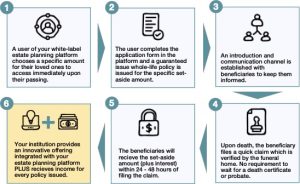
When you offer your clients, members, customers or employees the OneDigitalTrustTM  estate planning platform, branded as your own, any user can choose to opt-in by clicking on a link and completing a simple application form, while being assured of the following:

  • Guaranteed issue whole life policy *
  • No health questions
  • No medical exam or tests
  • No required ongoing premium payments
  • PLUS, BENEFICIARY ACCESS TO POLICY FUNDS WITHIN 24-48 HOURS

Once submitted, the application is reviewed and a single premium, whole life insurance policy is issued for an amount as chosen by the user. The policies are issued by Homesteaders Life Insurance Company, who works directly with any licensed funeral homes across the country to complete the claims process. When the beneficiaries of any user file their claim through a licensed funeral provider, the funds are disbursed within 24 – 48 hours.

As a result, there is no need to wait for a copy of the official death certificate to access inherited funds which can take 4 – 6 weeks after requesting from The Department of Health & Human Services (DHHS). Plus, the time to submit the death certificate and file the claim with the financial institution holding the funds, can realistically add another 3 – 4 weeks.


A User-Specified Amount Disbursed To Beneficiaries Within 24-48 Hours of Death To Cover Essential End-of-Life Expenses


For Financial Advisors

The integration of BLP into the OneDigitalTrustTM platform offers a particularly powerful tool to strengthen client relationships and extend them to the next generation – a crucial aspect of long-term practice management. By offering this comprehensive solution, advisors can demonstrate their commitment to clients’ long-term financial well-being, even beyond their lifetime. This approach may also help mitigate situations where beneficiaries might face frustrating delays in accessing inherited funds, potentially blaming the advisor for circumstances beyond their control. Further, this new capability serves as an excellent conversation starter for advisors and allows them to broach the often-sensitive topic of estate planning in a constructive manner, highlighting the practical benefits of immediate liquidity for beneficiaries. This can lead to more comprehensive financial planning discussions and potentially uncover additional planning needs or opportunities to serve the client.

The OneDigitalTrustTM platform, bolstered by BLP, truly serves as the final piece of a robust financial plan. It creates a bridge between generations, ensuring that an individual’s financial legacy translates into immediate support for their beneficiaries.

For Institutions

Now institutions can go even further than offering an essential and affordable digital estate planning platform to their members, customers and employees. With the BLP integration, the white-label OneDigitalTrustTM platform can provide stakeholders with an unprecedented level of control over their legacy. This allows users to extend their care and support for loved ones beyond their lifetime, ensuring that their passing doesn’t create undue financial hardship. This capability adds even more peace of mind to customers, members and employees, knowing that even in death, they can still provide for their family’s immediate needs. By offering this innovative capability, pre-integrated into the OneDigitalTrustTM platform, extends the comprehensiveness of the platform to new heights by offering peace of mind and financial security that goes well beyond an individual’s lifetime, truly connecting generations through thoughtful financial planning.

This new capability represents a significant step forward in digital estate planning, acknowledging that a comprehensive plan must address not only the long-term distribution of assets but also the immediate financial needs that arise upon a person’s passing. Institutions can garner the following benefits:

  • Further augment personal & family wellness
  • Amplify brand-loyalty through an affordable & comprehensive platform-offering
  • Generate revenues from platform subscription PLUS insurance commission

Conclusion

The integration of the Beneficiary Liquidity Plan® (BLP) into the OneDigitalTrustTM platform marks a significant evolution in digital estate planning. It addresses a crucial need that has long been overlooked in traditional estate planning approaches, providing immediate financial support to beneficiaries when they need it most. For financial advisors, it offers a powerful tool to enhance their service offerings and strengthen multi-generational client relationships. For institutions, it equips them to deliver even more peace of mind to their customers, members and employees by providing them with a tangible way to care for loved ones even after they’re gone. As the financial planning landscape continues to evolve, innovations like this set a new standard for comprehensive, thoughtful, and truly impactful digital estate planning.

⎯⎯⎯⎯⎯⎯⎯⎯⎯⎯⎯⎯⎯⎯⎯⎯⎯⎯⎯⎯⎯⎯⎯⎯⎯⎯⎯⎯⎯⎯⎯⎯⎯⎯⎯⎯⎯⎯⎯⎯⎯⎯

The Beneficiary Liquidity Plan® (BLP) was founded by industry experts with decades of experience in working with top financial advisors. They recognized the need for an innovative solution to help individuals provide their loved ones with quick, easy access to funds following their death and enable advisors to build and maintain relationships with their clients’ beneficiaries.

Insurance policies under the plan are funded by Homesteaders Life Company, a mutual company and national leader in providing products and services to promote and support the funding of end-of-life expenses.

Categories
Blog INSIGHTS

Estate Planning for Same-Sex Couples: Addressing Unique Challenges and Leveraging Digital Tools

Estate planning is a critical piece of the puzzle for anyone leaving a financial legacy, but same-sex couples can face unique questions and challenges.

That’s because while same-sex marriage is now widely legally recognized, couples can still encounter hurdles that can complicate estate planning. Financial advisors at trusted institutions such as credit unions and community banks are in a great position to help.

While it’s always the right time to build relationships that benefit both clients and providers, Pride Month is an excellent time to examine how trusted advisors can help meet the unique circumstances that committed same-sex couples—legally married or not—might encounter.

These can include:

Legal Variability: Despite federal recognition, state laws can differ significantly, impacting inheritance rights and spousal benefits.

Family Dynamics: Same-sex couples might face resistance or complications from family members who may not recognize their relationship, leading to potential disputes over assets.

Parental Rights: Establishing and maintaining parental rights can be more complex for couples with children.

Health-Care Directives: Ensuring that medical decisions are honored often requires clear, legally binding health-care directives, which can be particularly crucial in jurisdictions less supportive than others of same-sex relationships.

While everyone’s situation is unique, and there are limits to what a financial advisor can do to address matters beyond finances, there are some very good ways to help provide peace of mind to same-sex couples regarding their estate planning.

The Necessity of Wills and Trusts

To protect their rights and ensure their wishes are honored, same-sex couples should prioritize creating wills and trusts. Here’s why these documents are indispensable:

Wills: A will ensures that assets are distributed according to the will creator’s wishes, reducing the risk of disputes and helping to ensure that partners and non-biological children receive their intended inheritance.

Trusts: Trusts offer additional benefits such as avoiding probate, maintaining privacy, and providing for complex family situations, such as ensuring ongoing care for a partner or children.

Power of Attorney: Establishing power of attorney is critical for managing financial and healthcare matters, particularly in emergencies where one partner may be incapacitated.

DIY Estate Planning Tools: Empowerment and Efficiency

Naturally, many couples are interested in using the internet first. A feature-rich online estate planning solution allows clients to do what they want independently. At the same time, you stand ready to provide individualized, in-person assistance whenever they need it.

This dual approach begins with powerful, sophisticated, and user-friendly estate planning tools like those from OneDigitalTrust. The platform’s features include:

User-Friendly Interface: Clients can easily navigate the process of creating wills, trusts, and other essential documents.

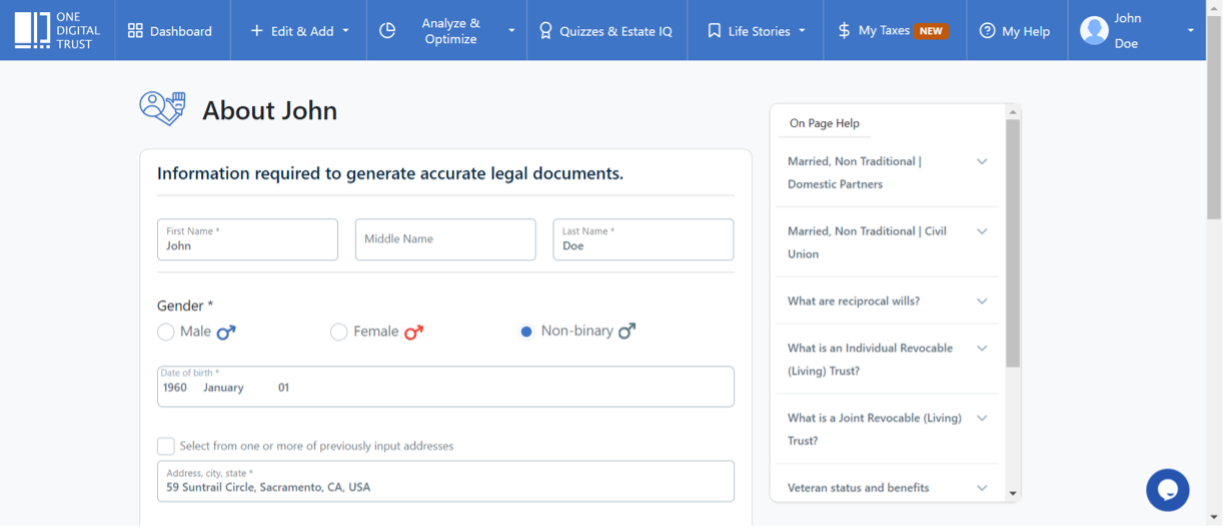
OneDigitalTrust allows LGBTQ+ users to:

  • Choose a marital status specific to their state, including registered domestic partners, civil union or legally married under state laws

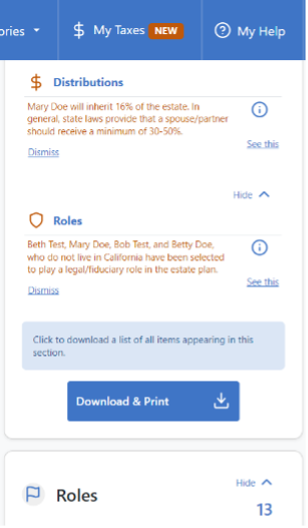
  • The platform notifies users of elective share information that may apply per state-specific laws on minimum inheritance requirements including relevancy to same-sex couples

  • Accurately reflect gender pronouns for people in the system designated as “non-binary”

Comprehensive Support: Advisors can assist clients at any stage, from initial planning to finalizing documents, helping to ensure that all legal requirements are met.

White-Label Solutions: Financial institutions and advisors can customize the platform to reflect their branding, reinforcing their role as trusted advisors.

Securing Their Legacy While Growing Your Bottom Line

Careful estate planning, including airtight legal documentation, is crucial for all couples to ensure that rights are protected and wishes are honored.

Digital platforms like OneDigitalTrust not only simplify the process, including for same-sex couples’ challenges, but also enhance the client-advisor relationship by offering accessible, efficient, and comprehensive solutions.

Financial advisors who embrace these tools can better serve all their clients, helping them meet the desire to financially protect and support loved ones that is common to all of us regardless of sexual orientation, racial identification, religious affiliation, or any other demographic.

OneDigitalTrust’s technology achieves this while also giving your organization a double bottom line: you’re helping your clients secure the execution of their final wishes while generating a reliable flow of fee income for your organization.

170M Americans need an estate plan. OneDigitalTrust offers a white-label, turnkey estate planning platform with pricing options tailored to the needs of individual credit unions and financial advisors.

Contact us today to learn more!

Categories
Blog INSIGHTS

Cracking the Code: How to Help Mass Affluent Clients Embrace DIY and Advisor-Assisted Estate Planning

Many financial advisors, particularly those serving clients through credit unions and community banks, face a challenge: how to effectively engage the “mass affluent” market.

These folks have a household income of at least $75,000 and liquid assets of between $100,000 and $1 million. They comprise one-quarter of our nation’s population.

They are the middle class and the sweet spot for financial advisors. Their numbers are significant, and they are primed for advisors to help them build for retirement and end-of-life planning. Effective, efficient estate planning will cement their personal legacy for their loved ones and cherished causes, as well as reduce unnecessary hassles for their families after they pass.

One key to unlocking this market lies in dispelling a common myth: top-shelf financial planning is reserved for the high-net-worth crowd.

You’re in an ideal position to extend your financial institution’s status as a trusted preferred financial institution (PFI) beyond savings and loans into investing and estate planning. And you can combine high tech and high touch by mixing do-it-yourself digital and face-to-face interaction to pull it all together. Let’s discuss how.

The Power of Small Steps in Estate Planning

Think back to the countless times you’ve encountered a client hesitant to begin investing because they don’t believe they have enough to make it worthwhile. You likely countered with the power of compounding interest, demonstrating how even small, regular contributions can grow substantially over time.

The same principles of starting early and building in small increments apply here, also. That begins with dispelling their misconception that estate planning necessitates a complex web of trusts and other legal documents.

The reality is that a fundamental plan—a will, beneficiary designations on accounts, and perhaps a power of attorney—can provide a strong foundation for the mass affluent. And they can accomplish this for a fraction of the cost they might have thought.

Here are some solid steps to follow:

  • Compounding Clarity: Frame estate planning as a way to safeguard their legacy. Just like consistent investments grow over time, a clear plan provides long-term peace of mind for them and their loved ones.

Start by guiding clients through all the people they’d like included in their estate planning. For a basic will, they can assign percentages, and it’s pretty much done. And, within OneDigitalTrust’s platform, your clients can always convert to a custom will or trust later. Custom wills can get very granular into who receives what when the family member passes.

  • Start with the Basics: Highlight the importance of having a will or basic trust, even for those with a seemingly straightforward financial picture. Explain how that ensures their wishes are followed and avoids potential family conflict during a difficult time.
  • Small Steps, Big Impact: Emphasize that simply starting is a crucial first step. As their wealth and life circumstances evolve, they can easily adapt the plan on their own or with your help as their trusted financial advisor. If they convert to a custom will or revocable trust, they can adapt beneficiaries and inheritances as desired.

Digital Tools Empower DIY and Advisor-Assisted Planning

As with banking and investing, technology has revolutionized estate planning, making it more accessible and affordable for the mass affluent. Tools like OneDigitalTrust’s digital estate planning platform empower clients to take control of their wishes while offering valuable opportunities for advisor involvement.

Here’s how these tools can benefit both you and your clients:

  • Client Empowerment: Digital platforms guide clients through creating a basic estate plan, fostering a sense of control and understanding.
  • Increased Accessibility: OneDigitalTrust’s tools are available 24/7, allowing clients to work on their plans at their own pace and convenience.
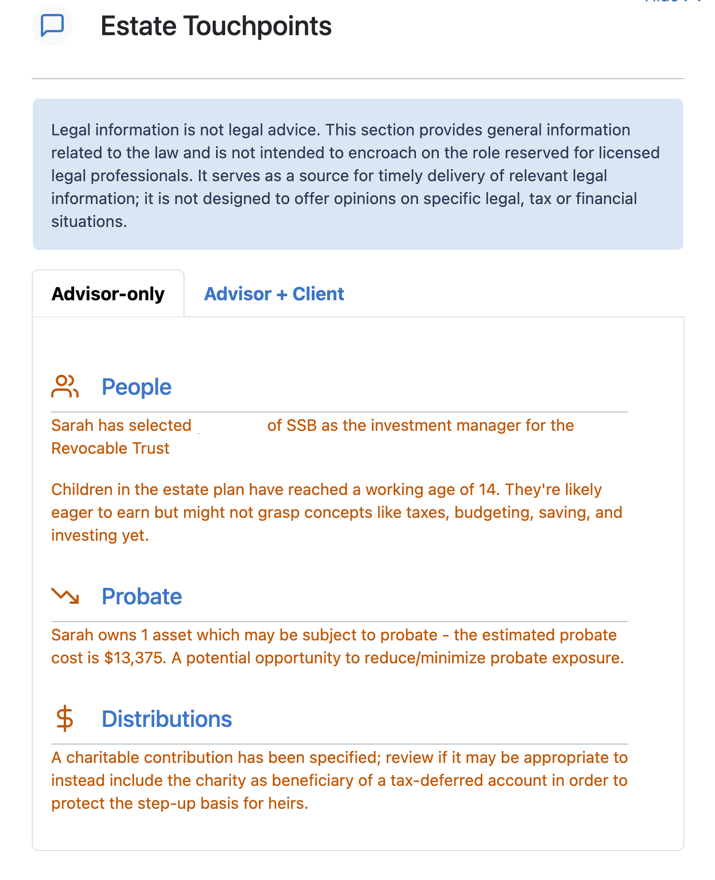
  • Enhanced Communication: Digital platforms can facilitate communication between you and your clients, allowing for clarification of questions and updates to the plan as needed. Inside our Advisor Portal, financial advisors receive nuggets of vetted advice to share with their clients, making you look sharp and building even more trust that you’re on their side.

estate planning touchpoints image

Positioning Yourself as the Trusted Guide

While DIY tools empower clients, it’s crucial to position yourself as the trusted advisor who complements the technology. Here are ways to leverage your expertise:

  • Review and Refine: Offer to review a client’s DIY plan, ensuring it aligns with their specific goals and circumstances.
  • Tax and Legal Nuances: Explain how even a basic plan can benefit from the guidance on tax implications and potential legal complexities.
  • Complexities and Future Needs: Discuss situations where a DIY approach may not suffice, and clients should follow your and OneDigitalTrust’s guidance when the need for more sophisticated planning arises.

Over time, your trusted relationship with your client will build, and based on your experience with them and others, you’ll see opportunities and pitfalls for them that you can then share and advise, creating opportunities for deeper service and upselling.

Unlocking the Mass Affluent Market

Remember, the cornerstone of successful financial planning is building trust and empowering clients to take control of their financial future.

By offering a combination of accessible technology and your expert guidance, you can become their go-to for helping them build, enjoy and then pass on their financial legacy, one well-informed step at a time.

170M Americans need an estate plan. OneDigitalTrust offers a white-label, turnkey estate planning platform with pricing options tailored to the needs of individual credit unions and financial advisors.

Contact us today to learn more!

Categories
Blog INSIGHTS

Break the Habit: Digital Estate Planning as an Essential Tool and Differentiator

The time and complexities involved in providing estate planning have long made it an outlier as a service. Investment advisors and wealth managers at traditional credit unions, banks, insurers and other financial services providers have been relegated to the sidelines as they refer their clients, customers and members to attorneys, as is the typical practice.

That practice, however, is changing as financial services continue to rapidly evolve in the digital world. Your organization will no longer have to pass your consumers—as well as the income they can generate—on to lawyers, keeping you from deepening those relationships.

Virtual estate planning platforms have been hard at work, developing their digital muscles, eradicating the need for attorneys, and even in-person servicing if an individual chooses. Empower your firm to break the habit of making third-party referrals and to deepen the personal touch and value they build with their clients, helping those they serve to navigate their financial lives and plan their legacies more holistically.

A Hybrid Advisor-Client Experience

“A streamlined digital estate planning platform delivered as a hybrid advisor-client experience provides a unique opportunity for advisors to expand their service model, amplify relationship alpha, power retention, and create advisory pathways to the next generation of clients,” a new report from Javelin Advisory Services reads.

Titled “Digital Estate Planning: A New Frontier for RIAs,” the think tank’s report focuses on the power of digitizing the creation and storage of relatively simple but vitally important documents such as wills, revocable trusts, and medical directives. It cites OneDigitalTrust as a leader in creating that new nexus of advancing fintech innovation and growing advisor value, as shown in the illustration below.

Javelin Research found OneDigitalTrust to provide advisors innovation and value.

The Relationship Alpha for The Next Aging Generation

Millennials have surpassed baby boomers as the largest generation in the United States. Those 20-somethings to 40-somethings are digital natives. They’re accustomed to living online – including working, shopping, learning, and banking – but they’re still real, live human beings, naturally, who can benefit from professional guidance and advice through their journeys.

Along with traditional matters such as raising families, forging and maintaining careers, caring for aging relatives, and the vicissitudes of aging, they also find themselves with their own unique set of stressors, as the Javelin report astutely illustrates in this figure below.

Platforms like OneDigitalTrust help to calm financial services providers clients' anxiety, Javelin found.

The “Demographics” section in the above figure includes “increased personal wealth,” among other factors that present an opportunity to RIAs and other financial services providers who can most seamlessly and effectively combine high-tech and high touch for this cohort of adult Americans.

As the report observes, all these factors imply that scaled delivery of personalized solutions points to demand for an enhanced user experience. Digital estate planning combined with direct conversations with clients about this particularly weighty topic helps cement that relationship with the client and potentially with the other stakeholders in the next generation, especially if they, too, join the discussions.

Ultimately, it’s about the effectiveness of advisor-client communication, a significant currency that makes financial advisors more than order-takers in a digital world of cookie-cutter, low- or no-cost options. That’s not a recipe for long-term success.

“The legacy [estate-planning] conversation is emotional, often covering philanthropic and generational aspirations,” the Javelin report observes. It points to this empowering feature in our platform: “OneDigitalTrust, for example, creates a client area where notes can be appended to the system, allowing the client to memorialize and express those aspirations and sentiments for advisors, kids and other beneficiaries.”

Differentiation and Commoditization

That vital communication feature – among others – helps OneDigitalTrust continue to push out the leading edge of humanizing digital estate planning and, most critically, the ability for advisors to differentiate themselves in the uber-competitive fintech world.

OneDigitalTrust, as the Javelin report observes, is also out front with integrating personal financial data into its platforms. That gives financial services providers the ability to wade through multi-party, multi-platform morass to add even more value.

Financial services providers are keenly aware of the commoditization of their products and services and the need to differentiate. A robust foundation for that is personal service that uses digital products to help leverage meaningful conversations around the unique access financial planners have to their clients’ assets.

That conversation should include how to distribute those assets when the time comes without sending that part of the business elsewhere. “Advisors must consider expanding their business model by leveraging digital estate planning solutions,” the Javelin report concludes. “New channels of dialogue are opened with beneficiaries and family members who can become clients and advocate for the advisor’s expertise.”

And that helps the advisor and their employer build their value and legacy.

170M Americans need an estate plan. OneDigitalTrust offers a white-label, turnkey estate planning platform with pricing options tailored to the needs of individual credit unions and financial advisors.

Contact us today to learn more!

Categories
Blog INSIGHTS

Digital Estate Planning Empowers Your Customers to Avoid These 3 Mistakes

Estate planning is a task easily set aside amid the demands of daily life. But life will indeed end, and your customers should have a proper estate plan in place. Even when their assets are modest and require a simple will, it is crucial for every working adult who would like to ensure what happens to their family and their assets after they’re gone.

Only about one-third of all Americans have created a formal estate plan. For the two-thirds who do not have one, that’s a serious problem for them and their families. It is also an opportunity for financial services providers, like wealth managers, financial advisors, credit unions and banks to step up with solutions that combine digital ease and personal touch to make estate planning accessible and affordable for everyone.

Your trusted relationship as a financial services provider gives you the perfect segue to help your customers and members avoid some estate planning mistakes that can cause their loved ones stress, conflict, expenses and other headaches down the road.

Here are three mistakes you can help your customers/members avoid:

1. Not Having an Estate Plan 

The biggest mistake – and most common – is doing nothing. About two-thirds of Americans do not have an estate plan, such as a will or trust. Without a legally valid estate plan, state intestacy laws require assets to be distributed by a probate court.

That costs time and money and heightens already frayed feelings. Family members and others with claims can tie things up over what others might consider surprisingly small amounts. Help your members and customers avoid that situation.

Also, not having a will can leave the court to decide about guardianship for minor children. A will or trust will establish the parents’ desires for who should continue caring for their children should they pass while the children are still minors.

2. Not Keeping Your Estate Plan Up-To-Date

Things happen. Customer and members’ life changes like marriage, divorce, new children and stepchildren, and changes in income and assets can change how a person wants their estate handled.

But wills are easy to set and forget, never revisited until it’s time for their execution. To ensure the plans are current, estate documents should be reviewed every couple of years or so and after significant life events.

A plan based on outdated wishes can lead to disputes between family members down the line. Offering estate planning documents that are easy to update will help keep your customers and members’ plans current and smooth out what could be a bumpy process.

3. Not Communicating the Estate Plan

Conversations about estates are always challenging, but they are ones we must encourage as responsible financial services providers. They are fraught with potential hard feelings about who gets what, of course, not to mention the difficulty of recognizing the eventual loss of a parent while both parent and child are very much alive. Not fun.

However, these conversations are essential for holistic financial wellness. Loved ones need to know what to do when that time comes. They should have access to critical documents and open conversations to avoid any confusion. That includes ensuring the documents remain up to date.

How Digital Estate Planning Can Create Winning Outcomes

As a trusted financial services provider, you can offer your customers and members digital estate planning solutions like OneDigitalTrust. We’ve built a robust platform that allows end users to create wills, trusts, power of attorney, healthcare directives and much more. Users truly appreciate the document tracking capabilities and digital vault for organizing the process and storing the documents.

Meanwhile, you are provided access to real-time, smart analytics to deepen relationships with customers and generate a new source of non-interest income. And because our platform is white labeled, you can offer it under your brand, and users know your organization is there to care for them and their families.

Many estate planning mistakes occur due to a lack of education and proper guidance, fear of acknowledging our human mortality, and consumers’ expectations of the cost of estate planning. OneDigitalTrust removes the lawyer from the equation, making creating legally valid estate planning documents much more affordable. We help you make it easy for the mass affluent to access compliant, responsible, plain-language estate planning. Integrating a trusted solution like OneDigitalTrust can help those who trust you achieve and maintain peace of mind around what can be such a sensitive and complicated subject, one all too easy to ignore otherwise.

170M Americans need an estate plan. OneDigitalTrust offers a white-label, turnkey estate planning platform with pricing options tailored to the needs of individual banks, credit unions, financial advisors, wealth managers, insurance companies, HR benefits providers and more.

Contact us today to learn more!

Categories
Blog INSIGHTS

Estate Planning Finds Purpose-Driven Entrepreneurship in Rocky Mehta

Sadly, most Americans have not done their estate planning or have let it get out of date.

That is part of the impetus for CEO Sonny Kapoor and co-founder Rocky Mehta to found OneDigitalTrust, a pioneering digital estate planning service, to help spare families during their darkest time, the complex and costly work of dealing with the estate of a loved one who died without a legally valid estate plan in place.

Recognizing an untapped opportunity to address the needs of the underserved and mass affluent, Kapoor and Mehta determined to follow their personal mission to build a platform that stands out in the competitive landscape by solving real-world problems.

Mehta sat down with co-founder of The Credit Union Connection, Sarah Snell Cooke, to share insights into the company’s mission and B2B model to help them reach more people quickly.

Sarah Snell Cooke: What’s OneDigitalTrust’s founding story – where did you get the idea for this company?

Rocky Mehta: OneDigitalTrust’s founding story has been the culmination of two things: Our CEO Sonny Kapoor and I have been in the financial services consulting space for most of our careers, and we saw this as an untapped opportunity for a digital estate planning service to meet the needs of the underserved and mass affluent.

Second, my co-founder and I have first-hand experience with family members with special needs, and we’ve seen a massive uptick in younger generations needing extra support. We felt we could make a difference by helping Americans afford to protect their families and legacies with our offering.

SSC: What problem are you trying to solve?

RM: All Americans should have their end-of-life affairs in order. No one knows when the worst could happen to us, but death and taxes are unavoidable. For whatever reason – putting off a morbid necessity or thinking you don’t have enough assets to worry about or trying to avoid the high cost of an attorney to create an estate plan, Americans don’t plan their estates.

Depending on who does the survey, an astounding 65% to 70% of Americans don’t have estate plans in place, or if they do, it needs to be updated. Both scenarios can lead to stressful and expensive work thrust upon their survivors. That’s the problem we’re solving!

SSC: Tell me a bit about your background.

RM: I come from a technical engineering and computer science background, and I went to business school afterward, which allowed me to serve as a liaison between technology and business. That helps me work with all of our teams from technology, legal, operations and sales & marketing to enable us to run a successful business to serve our clients and, in turn, their members or customers.

SSC: How are you planning to reach all Americans?

RM: I mentioned our mission is to support Americans to protect their lives and legacies, but it can be incredibly difficult to reach each of them individually. This problem has proven rather obstinate as the needle has barely moved over the last decade, which is why we believe that delivering estate planning through institutions (versus the status quo) will be the turning point when this needle moves. From the start, we knew we needed to work with other trusted businesses to enhance their services to their customers and members. Our partners are in the financial wellness field and include credit unions, banks, financial advisors, insurance companies, and employee benefits providers. This business model helps us to reach everyone faster and ensure they complete this vital task to protect their legacies and not leave a mess behind for their heirs to resolve. That can be very painful and expensive, as we all know from celebrities who’ve passed on without proper estate planning, including the King of Pop, Michael Jackson, and billionaire entrepreneur Howard Hughes.

SSC: How are you different from your competitors?

RM: The good news is that there is competition, and in the last two years even more competitors have entered the business. That means more people recognize that not having an estate plan is a massive problem that must be solved.

There is room for several players in this emerging market to help solve this brewing crisis across America in their own ways.

We have many unique advantages. We are an enterprise-level solution, and we partner with institutions to provide them the flexibility to configure, brand and price the value-proposition as they see fit to best serve their mission, target audience of ideal members and customers, and style of how they want to serve. With 170M Americans lacking an estate plan, OneDigitalTrust offers a white-label, turnkey estate planning platform with wholesale pricing options tailored to the needs of individual credit unions, banks, financial advisors, insurance agencies and HR benefits companies.

The real-time analytics capabilities offer our partners insights to better understand customer needs and identify opportunities to cross-sell and upsell. OneDigitalTrust provides financial services providers and financial institutions measurable opportunities to better support and understand their customers and members’ needs. I could go on and on with the capabilities and benefits of our platform, such as the plain-language documents, affordability, and extreme value. Still, the best way to understand our platform is to request a demo to show how OneDigitalTrust can best help!

OneDigitalTrust fulfills a burgeoning need to ensure more Americans complete their estate planning and keep it updated. We will further document estate planning need-to-know information, OneDigitalTrust, and the founders’ personal mission and entrepreneurial journey, so please be sure to sign up for our newsletter in the footer of this page and follow us on LinkedIn!

Categories
Blog

Why is it important for credit unions to ensure members have a will or trust?

A death in the family ushers in a time that can be fraught with trauma and confusion. Questions around how to distribute that loved one’s assets via a will or trust, and who’s in charge of doing that, can be a particularly volatile part of the problem, even with modest estates.

Credit unions have always specialized in serving everyday people, and they can play a unique role in helping their members by making it easy for them to create estate planning documents, such as wills and trusts.

While there are some key differences, wills and trusts achieve the same end: They ensure the deceased person’s belongings, financial assets and real property are distributed according to their wishes. Without that, a person has died ‘intestate’ and state laws on ‘intestacy’ kick in, and that means leaving those crucial decisions up to probate courts and wrapped in red tape.

Wills are usually the first choice to consider for estate planning, and while they typically must go through probate, a concise, legally created will generally makes that a simple process. More complex situations, such as blended families, special-needs dependents and business assets might benefit even further from a clearly outlined trust.

Estimates are that about two-thirds of Americans don’t have a will or trust in place. Helping to ensure families address this critical aspect of financial planning in advance is yet another way your credit union can promote members’ financial well-being.

A natural next step in member service

Credit unions were established for people who otherwise could not obtain credit from banks to pool their assets and offer loans to each other. In recent decades, credit unions have greatly expanded their range of services and their commitment to providing complete financial care for members’ holistic financial wellness.

Indeed, your credit union may offer financial education materials already to improve members’ money management. Adding estate planning into the mix is a natural next step. A surprising number of adults do not have these end-of-life documents in place and education is a huge part of moving the needle in the right direction.

Encouraging members to outline an estate plan can prevent your staff from being caught in the middle of a traumatic financial and familial nightmare after the death of a member without proper documentation.

Instead of acting as a neutral third party trying to sort out a messy situation around account funds and asset distribution, you can point grieving families to the member’s documented wishes. This allows you to avoid emotionally charged conflict during an already difficult time.

A digital solution checks all the boxes for this generation and the next

Millennials are now the largest generation, they’re also often homeowners and parents at the stage when estate planning becomes particularly crucial to ensure proper distribution of assets and care for minor children should the unexpected befall them. It should be part of their overall financial awareness and action. And, as the generation who hit this stage of life during a global pandemic, it’s likely top of mind for them, too.

Additionally, your credit union can become an integral part of the “great wealth transfer.” What is that? It’s the $72 trillion in wealth currently held by baby boomers, much of which will be inherited by their millennial children. There’s ample opportunity for your credit union to provide a valuable service to these members, as well as be compensated for it in a way that is not interest-rate sensitive: non-interest income.

Millennials are also the first wave of members who expect to accomplish most everything digitally first. Providing a secure way to create and manage wills, trusts and similar documents through your credit union’s digital banking provides a new level of service to them and stickiness for you.

With a white-label digital solution fully integrated into your existing platforms, you can take credit for providing an innovative service that members will appreciate through one of the interfaces they already use and trust – your digital banking. Keep pace with the technological expectations of your younger members while building loyalty!

Delivering value while promoting responsible planning demonstrates your commitment to your members’ overall financial well-being. Digital estate planning checks all the boxes for why credit unions exist and how they can best serve member needs today. OneDigitalTrust delivers white-label, turnkey estate planning capabilities for legally valid documents in all 50 states, plus DC, with the highest data security and enterprise scalability. Is your credit union ready to take the next step in holistic member well-being?

170M Americans need an estate plan. OneDigitalTrust offers a white-label, turnkey estate planning platform with pricing options tailored to the needs of individual credit unions and financial advisors.

Contact us today to learn more!

Categories
Blog

Why Executors & Advisors need to be concerned about undue Influence leading to (financial) elder abuse

The Problem

The population in the U.S. is aging rapidly with the 65+ age group poised to double within the next 20 years. An unwanted, yet invariable side-effect is that the occurrences of (financial) elder abuse will also experience a remarkable increase. As the level of incapacity progresses among the seniors in our population they become more vulnerable to undue influence leading to financial elder abuse. An example is – dementia. With 10 million people suffering every year from symptoms including memory loss, diminished decision-making and trouble communicating, dementia is robbing our older population of both their daily functioning and their agency. Already, a massive demographic of citizens are vulnerable to undue influence. This concerning trend sets the groundwork for a deeper look into  “undue influence”, and how it affects incapacitated people.

What is “Undue Influence”?

Undue influence does not have a one size fits all definition. However, in every situation involving undue influence, common elements emerge: an incapacitated person, unable to make their own decisions, maintains a close relationship with an individual who possesses some level of authority over them. This enables them to make decisions on the incapacitated person’s behalf and ultimately manipulate the situation for their own benefit. 

In a legal sense, some states define undue influence as when a fiduciary or confidential relationship exists in which one person substitutes his own will for that of the influenced person’s will. This usually occurs when a mentally or physically incapacitated person creates their will before their health issues begin, and someone convinces them to change their wishes after they are incapacitated. This could happen when a family member isolates the incapacitated person from other relationships, influencing them to distrust others and eventually pressures them to make certain decisions that they wouldn’t make if not persuaded. However, Executors, Advisors and loved ones can do their part to ensure that the wishes of the incapacitated person are being respected and carried out.

What can financial advisors and executors do?

Executors and Advisors should be aware that the overwhelming majority of undue influence is motivated by family members seeking (financial) benefit from committing elder abuse – children and spouses/partners may often be the key offenders. As a financial advisor or an executor for someone beginning to show signs of incapacity, which is preventing them from making their own decisions, it’s important to be aware of the threat of undue influence. An example is – to notice when the person has become highly dependent on a specific person for help with daily functioning, emotional or financial decision-making. Also, be aware if this specific person is seemingly always supervising or accompanying them in a way that seems to be allowing the person to exert control. These could be red flags that undue influence can occur shortly, if not already.

There are measures that can be taken to prevent your client or loved one from becoming a victim of it. Financial advisors could leverage a comprehensive estate planning platform to properly document their incapacitated client’s wishes and financial goals that were discussed when they were still able to make their own decisions. Both financial advisors and executors of incapacitated individuals should be watchful for repeated signs of growing incapacity – memory, hygiene, judgment, mood among other factors and maintain consistent communication with the incapacitated person’s family members and trusted caregivers to watch for any signs of undue influence. 

How “smart” digital platforms can help

Another key observation is that prior to the introduction of online estate & inheritance planning platforms, undue influence was much harder to commit. It could take a long time to convince an incapacitated person to change their mind about their wishes and then visit the  attorney’s office to  get a modified will drawn up. In this new age of all-digital technology, online estate planning platforms make it simple and affordable for users to create estate plans and make unlimited changes (small and large) rapidly. 

As a result, it’s more important than ever for such digital technology platforms to embed “smart” safeguards to uncover and detect undue influence from becoming more commonplace for our elderly population. 

To prevent (financial) elder abuse from occurring in the first place, Executors, Advisors and loved ones are required to develop heightened awareness to safeguard seniors as they detect signs of oncoming incapacity. The Advisor Portal from OneDigitalTrust leverages “smart” technology to notify Advisors in cases where high(er) characteristics of (financial) elder abuse may exist. 

Schedule a demo to see the OneDigitalTrust  Advisor Portal in action. 

By Alia Hardy
Customer Success Team